President John Dramani Mahama has challenged Ghana’s diplomatic missions to secure tangible economic benefits from the country’s international partnerships, insisting that economic diplomacy must deliver investment, industrial growth, technology transfer and jobs for Ghanaians.
He said Ghana’s application for partnership with BRICS was part of efforts to expand the country’s economic opportunities, diversify its development partners and strengthen cooperation with emerging economies without abandoning its traditional international relationships.
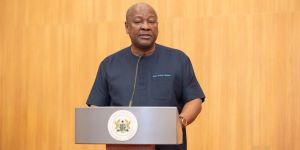
President Mahama gave the directive during the swearing-in ceremony of newly appointed envoys at the Jubilee House on Friday, October 16, 2026.
He urged the envoys to move beyond routine diplomatic engagements and agreements to pursue opportunities that directly support Ghana’s development priorities.
“Judge the success of your economic diplomacy by the opportunities you are able to bring to Ghana,” he told the diplomats.
The President said Ghana’s engagement with BRICS should be understood within the broader objective of strengthening the country’s economic position in a rapidly changing global environment.
“Ghana’s decision to apply for partnership with the BRICS countries reflects our determination to broaden our development partnerships and deepen South-South cooperation,” he said.
He explained that the initiative was intended to open up additional avenues for trade, investment, industrialisation and value addition while preserving Ghana’s longstanding relationships with traditional partners.
Diplomacy tied to economic transformation
President Mahama said shifting global alliances, rising trade restrictions and intensifying competition over technology and natural resources required Ghana to adopt a more strategic approach to its foreign relations.
He maintained that the country must protect its ability to make independent decisions while building partnerships that strengthen domestic production, industrial capacity and international competitiveness.
Against this backdrop, he tasked Ghanaian missions abroad with identifying investors whose interests align with the country’s development agenda and helping local businesses access new international markets.
The envoys were also directed to pursue partnerships that would facilitate research, skills development and technology transfer to support the growth of local industries.
President Mahama emphasised that diplomatic missions must take responsibility for following through on investment proposals and agreements rather than allowing them to remain unimplemented.
He urged them to identify obstacles that could delay projects and work with the Ministry of Foreign Affairs and other relevant institutions to resolve such challenges.
Natural resources at the centre of economic diplomacy
The President further highlighted Ghana’s efforts to retain more value from its natural resources, citing the establishment of the Ghana Gold Board and initiatives to promote local processing of critical minerals, including lithium, bauxite and manganese.
He said Ghana’s diplomatic engagements should help attract the capital, expertise and technology needed to transform these resources into productive industries and sustainable employment.
The approach, he indicated, would require foreign missions to prioritise investors capable of supporting local processing and strengthening Ghana’s productive capacity.
By linking international partnerships to industrialisation and value addition, the government aims to ensure that the country’s natural resource wealth contributes more significantly to domestic economic development.
Diversifying partnerships without abandoning traditional allies
President Mahama stressed that Ghana’s pursuit of BRICS partnership did not signal a departure from its established relationships with traditional development partners.
Rather, he said, the country intended to widen its options and strengthen its negotiating position by engaging a broader range of international partners.
The President’s remarks place economic diplomacy at the centre of Ghana’s foreign policy, with diplomatic missions expected to play a more active role in attracting investment, expanding export markets and supporting the government’s industrialisation agenda.
He maintained that the ultimate measure of the country’s international engagements should be their contribution to economic opportunities and improved livelihoods for Ghanaians.