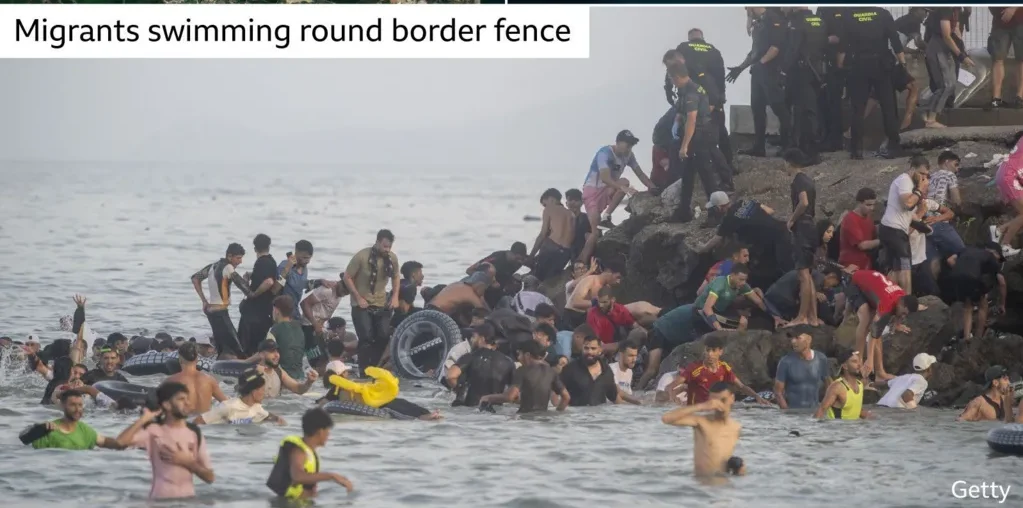
A massive influx of migrants into the Spanish North African enclave of Ceuta has triggered a humanitarian emergency and a diplomatic dispute across Europe, after about 60,000 people crossed from Morocco, leaving at least 57 people dead and thousands stranded.
The unprecedented surge has overwhelmed the small enclave, prompting Spain to deploy military forces and intensify security measures, while Italy suspended the Schengen free-movement arrangements with Spain, citing concerns over border security.
Spanish Prime Minister Pedro Sánchez described the mass crossing as a serious challenge to Spain’s sovereignty and blamed human trafficking networks for encouraging migrants to enter the territory.
He said criminal organisations had exploited a recent Spanish Supreme Court ruling, which held that migrants intercepted at sea while attempting to reach Ceuta or Melilla could not be summarily returned to Morocco.
“What has emerged from our talks with Moroccan authorities is that trafficking mafias took a self-serving interpretation of a Supreme Court ruling,” Sánchez said during a visit to Ceuta.
Spanish officials said that by Friday evening, more than 48,000 migrants had voluntarily returned to Morocco, while efforts continued to manage the remaining arrivals.
The crisis has placed enormous pressure on Ceuta, whose population is about 83,600, with local authorities saying the number of arrivals represented a significant share of the city’s residents.
Witnesses described chaotic scenes as thousands of migrants, many of them young men, entered the enclave by sea and land.
Carmen Gonzalez Bermudez, who was visiting family in Ceuta, said she saw “thousands and thousands of people in swimming costumes and all wet, just coming from the sea.”
She said many appeared to be searching for food and shelter, adding that the situation had left residents frightened.
Another resident, Víctor Ortiz Sotomayor, described the city as overwhelmed.
“I’ve never seen anything like it,” he said. “The city was packed with immigrants in every square and street.”
Officials estimate that around 7,000 of those who crossed are minors, including women, children and infants, raising additional humanitarian concerns.
The incident has also reignited tensions between Spain and Morocco, which have long disputed the status of Ceuta and Melilla, the European Union’s only land borders with Africa.
The crossings appear to have occurred after border controls broke down, with many migrants reportedly reaching the area near the border fence with little resistance.
European leaders reacted sharply to the crisis.
Italian Prime Minister Giorgia Meloni called the scenes “shocking” and described the influx as a security threat to Europe.
The Czech Republic also called for a temporary suspension of Spain’s Schengen membership, while Germany urged Morocco to immediately take back migrants who entered illegally.
European Commission President Ursula von der Leyen said the images from Ceuta were “unacceptable” and called for urgent action.
Spain, however, criticised some of the European reactions.
The Spanish Foreign Ministry summoned the Italian ambassador after describing comments from Italian officials as “improper” and lacking European solidarity.
Sánchez defended Spain’s handling of the crisis, insisting that cooperation with Morocco was ongoing and that border security would be reinforced.
Migration pressure on Ceuta and Melilla had already been rising sharply this year.
According to UN data cited by BBC Verify, 2,826 migrants had entered Ceuta by mid-July 2026, compared with 994 in 2025, highlighting a dramatic increase even before the latest surge.
The crisis has become one of the largest sudden migration movements in recent European history, exposing both the humanitarian risks faced by migrants and the growing political divisions within the European Union over border management and migration policy.