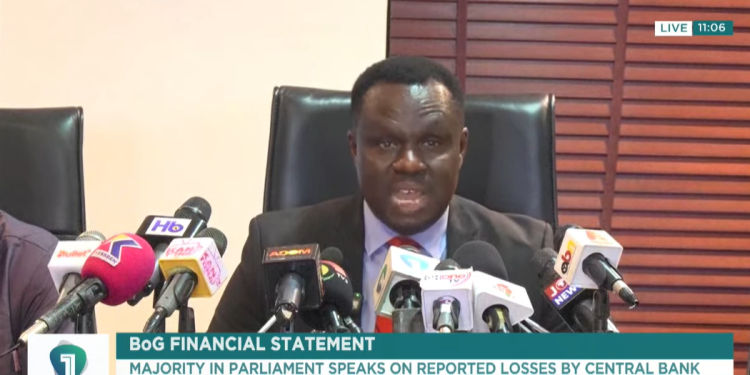
The Majority in Parliament has defended the Bank of Ghana’s GH¢15.6 billion loss in 2025, arguing that the financial setback is a direct consequence of economic challenges inherited from the Akufo-Addo administration.
Speaking to journalists, Chairman of Parliament’s Economy and Development Committee and Member of Parliament for Amenfi West, Eric Afful, said the previous administration failed to deliver macroeconomic stability despite the central bank recording cumulative losses exceeding GH¢80 billion between 2022 and 2024.
He argued that the huge losses under the previous government did not result in stronger economic performance, pointing to soaring inflation, a weakening cedi, and fragile foreign reserves.
According to him, inflation peaked at 54.13 percent in 2022 before easing to 23.84 percent by the end of 2024, while the cedi depreciated significantly to nearly GH¢14 to the US dollar by December 2024—representing a decline of about 19.7 percent.
He further noted that Ghana’s gross international reserves stood at approximately $9.3 billion in 2024, providing only four months of import cover for goods and services.
Mr Afful also highlighted the Bank of Ghana’s deteriorating equity position during the period, noting that it recorded negative equity of GH¢64.34 billion in 2023 before slightly improving to negative GH¢61 billion in 2024.
He maintained that the Bank’s 2025 loss should not be viewed in isolation but as part of broader monetary policy efforts aimed at restoring economic stability.
“Given these conditions, the 2025 financial outcome must be seen as a continuation of deliberate and necessary interventions to stabilise the economy,” he stated.
His comments come amid growing political debate over the Bank of Ghana’s financial health, following conflicting interpretations of the central bank’s latest audited accounts.