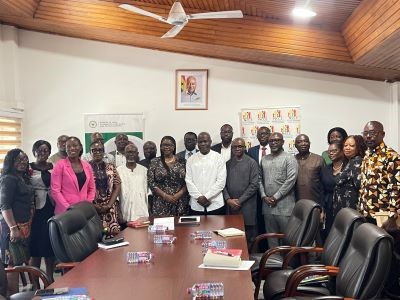
The Minister of Local Government, Chieftaincy, and Religious Affairs (MLGCRA), Mr. Ahmed Ibrahim, has called for a more empowered National Commission for Civic Education (NCCE) to bridge the gap between the government and citizens by effectively communicating public concerns to policymakers.
During a courtesy visit by the NCCE leadership to the ministry, discussions focused on civic education, accountability, and governance. The Minister emphasized that, as a non-partisan constitutional body, the NCCE must provide timely and accurate feedback on the needs and aspirations of Ghanaians to inform policy decisions.
Mr. Ibrahim acknowledged that the NCCE, since its establishment under the 1992 Constitution, has played a crucial role in promoting civic awareness, contributing to the smooth conduct of elections in the Fourth Republic. However, he expressed concerns that some of the commission’s key responsibilities, such as voter education, have gradually been taken over by other institutions, leading to a rise in rejected ballots during elections.
To address this, he proposed the inclusion of a dedicated budget for the NCCE within electoral planning to ensure widespread voter education and sensitization ahead of national polls.
Additionally, he highlighted the growing public misunderstanding of the NCCE’s mandate, exacerbated by the dissolution of the Ministry of Information. He suggested that the NCCE be empowered to take on a greater role in disseminating government policies to the public.
The Minister expressed concern over the decline in core societal values such as honesty, probity, accountability, and integrity—values that have historically upheld Ghana’s democracy. He stressed that the NCCE has a critical role in fostering civic responsibility and social cohesion, particularly among the youth.
“NCCE must take proactive steps to instill these democratic values in schools and communities to ensure the next generation grows with these principles,” he urged.
To enhance collaboration between the NCCE and local government structures, Mr. Ibrahim suggested integrating the commission’s input into the orientation of newly appointed Metropolitan, Municipal, and District Chief Executives (MMDCEs).
NCCE Chairperson Ms. Kathleen Addy reaffirmed the commission’s dedication to ensuring that all Ghanaians understand their civic rights and responsibilities. She underscored the importance of working with key partners, including traditional authorities, faith-based organizations, and local government institutions, to effectively execute the commission’s mandate.
She noted that in addition to its ongoing initiatives, the NCCE would prioritize public education on constitutional reforms and local government decentralization this year, as these processes require strong public engagement.
“The success of these reforms depends on citizens being well-informed, and the NCCE is preparing to take on this role,” she added.
With renewed governmental support and an expanded role, the NCCE is set to play a more significant part in shaping Ghana’s democratic governance and strengthening civic responsibility among citizens.