
















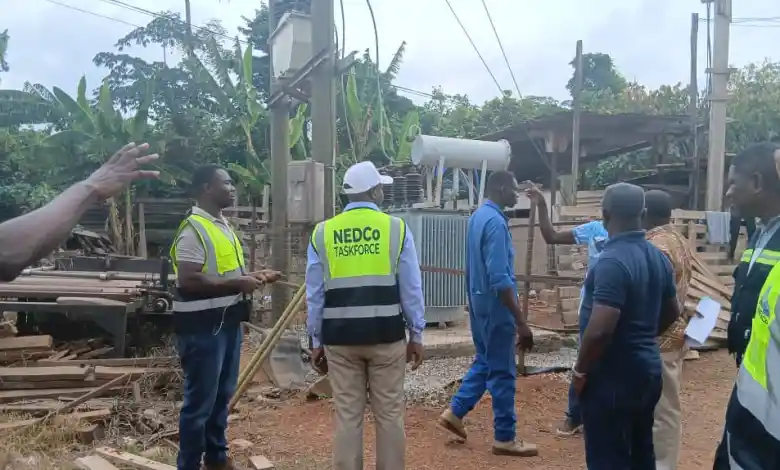
In a bold move to avert an escalating energy crisis, the Sunyani Area office of the Northern Electricity Distribution Company (NEDCo) has launched an aggressive revenue mobilisation and loss control operation in the Ahafo Region, targeting high-debt institutions as part of a broader strategy to stabilise Ghana’s struggling power distribution system.
On the first day of the exercise in Mim, Asunafo North District, NEDCo recovered over GHC 850,000, highlighting the scale of unpaid electricity bills crippling the utility provider’s operations. With Ghana’s power grid already under pressure from ageing infrastructure, overloaded transformers, and expanding demand, the company says non-payment is no longer a tolerable risk.
Engineer Augustine Akolgo Nsoh, Revenue Protection Officer for the Sunyani Area, said the situation had reached a tipping point. “We are running out of time and resources. We can’t keep the lights on without cash flow,” he warned, adding that all new service connections have been temporarily suspended to prioritise revenue recovery.
“This isn’t just about NEDCo. It’s about preserving the integrity of the national grid,” Engineer Nsoh said. “We owe money to key power suppliers like the Volta River Authority (VRA), and unless we collect what’s due, the entire chain—from generation to distribution—will suffer.”
The exercise, which began on Monday, April 7, saw officials descend on major industrial and commercial consumers in Mim. Ayum Forest Products Limited, which owed a staggering GHC 5.6 million, narrowly avoided disconnection by issuing a post-dated cheque of GHC 800,000. The company, which employs around 1,000 people, is now under watch for compliance.
Other facilities weren’t as fortunate. Power to Supremo Wood Processing Limited was cut off due to a debt of GHC 1.4 million, only to be reconnected after a partial payment. CookClean Ghana Limited, with an outstanding bill of GHC 51,000, had its supply disconnected, while RK Peprah Company Limited cleared GHC 70,000 of its GHC 10,595 debt to maintain access.
While some see the crackdown as harsh, NEDCo insists the exercise is about preservation, not punishment.
“We understand times are hard,” Nsoh said, “but energy cannot be free. If we don’t act now, we may not be able to serve even the paying customers. Everyone must share the responsibility of keeping the grid alive.”
Industry experts have praised the move as a necessary wake-up call for large power consumers who have long benefitted from access to electricity without matching it with timely payments.
The mobilisation exercise is expected to extend across other towns in NEDCo’s Sunyani operational zone in the coming weeks, as the company races against time to recover millions in arrears and restore financial health to Ghana’s power supply chain.






