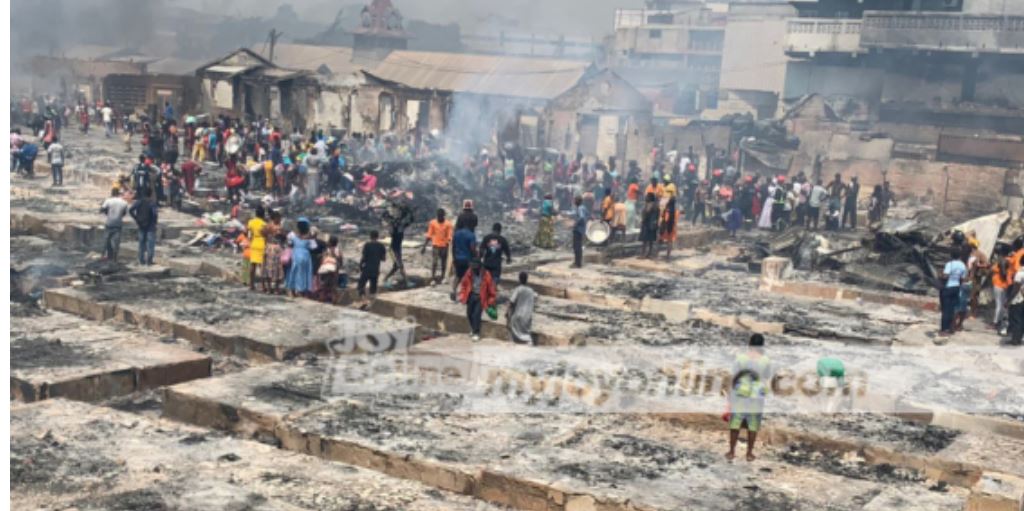
On the morning of 3rd January 2025 – just three days into the year, thick plumes of smoke could be seen rising above the Kantamanto market, a bustling commercial hub in the heart of Accra.
What began as a small fire, a day before, rapidly escalated into a massive blaze, reducing vast swathes of the market to smoldering ruins. The fire has left hundreds of traders devastated, with many losing not just their goods, but also their livelihoods.
Kantamanto market, known for its vibrant trade in secondhand clothes, electronics, and assorted goods, is a key economic lifeline for many in the capital city. The market is also a melting pot of small business owners, traders, and buyers from all walks of life. For the thousands who rely on this market for income, the fire has brought untold hardship.
A Scene of Chaos and Despair
As the flames raged, traders could only watch in horror as their stalls, goods, and years of hard work went up in smoke. Firefighters were on the scene within minutes, but the inferno had spread too quickly to contain. The cause of the fire is yet to be determined, but the scale of the damage is undeniable.
“I woke up this morning with hopes of making sales and supporting my family, but now I have nothing,” said Georgina Nartey, a trader who sold secondhand clothes in the market. “Everything I had is gone. All my stock, all my money—everything.”
Another trader, Kwasi Ampah , who specialized in selling electronic appliances, described the scene as “total devastation.” “I was in my stall when I smelled smoke. Before I knew it, the fire had consumed everything. All my stock, including expensive electronics, was burned to the ground.”
Many traders are now left without any immediate means of survival. Some, like Georgina and Kwasi, have been part of the Kantamanto market community for years, building up their businesses with hard-earned savings. With no insurance to cover their losses, many traders are uncertain about their future.
The Impact of the Lack of Insurance: A Stark Reality for Informal Sector Traders
The devastation at Kantamanto is not only a stark reminder of the vulnerability of informal sector traders but also highlights a critical issue—many of these traders have no insurance to cushion their losses.
In an economy where informal businesses make up a significant portion of employment, the lack of insurance coverage for traders like those in Kantamanto is a glaring issue that demands attention.
As of 2025, only a fraction of Ghana’s informal sector workers, including the majority of traders in markets like Kantamanto, have access to formal insurance schemes. The reasons for this are multifaceted and rooted in a combination of economic, cultural, and infrastructural factors.
Without insurance, these traders are left to bear the full financial brunt of events like fires, theft, and accidents, which can wipe out their entire livelihood.
A Hidden Struggle: The Informal Sector’s Insurance Crisis
In Ghana, the informal sector employs over 80% of the working population, according to the Ghana Statistical Service. However, the vast majority of these workers—small business owners, vendors, artisans—are not insured.
A UNDP report reveals that despite Ghana’s favorable environment for insurance, about 70% of Ghanaians do not have access to any form of insurance.
For the traders at Kantamanto, the fire is a catastrophic loss, and there is little recourse to recover their assets.
Source: Daryl Kwawu