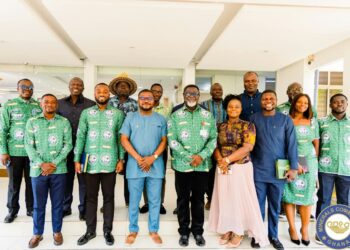
The Chief of Staff, Dr Julius Debrah, has urged Ghanaian universities and research institutions to move beyond producing academic knowledge and focus more on turning research findings into practical solutions to the country’s development challenges.
He said Ghana had considerable research capacity and innovative ideas but continued to face challenges in translating those ideas into products, services, businesses and policies that could directly benefit citizens.
“Ghana does not lack ideas,” Dr Debrah said. “Our main challenge is moving these ideas into use. We must become better at taking knowledge from the university and placing it where it can make a difference.”
He was speaking in a speech read on his behalf at the second edition of the Applied Research Conference of Accra Technical University (ARCATU) in Accra on Wednesday.
The conference, held on the theme, “Applied Research and Innovation for Sustainable and Resilient Development in the Era of Artificial Intelligence (AI),” brought together academics, researchers, industry players, policymakers, development partners and other stakeholders.
Dr Debrah said stronger collaboration between academia, industry and government was essential if research was to have a meaningful impact on national development.
He said such collaboration should begin from the early stages of research instead of being introduced only after researchers had completed their projects.
The partnerships, he said, should facilitate joint research projects, practical training, access to specialised facilities and support for innovative ideas capable of addressing national challenges.
Dr Debrah said the need for applied research had become more urgent as Ghana confronted rapid technological change, climate-related challenges, population growth and increasing pressure on public services.
“We cannot respond to these challenges with old answers. We need research that is connected to our national priorities. We need innovation that is suited to our conditions,” he said.
On artificial intelligence, the Chief of Staff said Ghana should focus on using the technology to create measurable value rather than simply adopting it because it was becoming globally prominent.
He said AI could strengthen planning, improve public service delivery and support evidence-based decision-making when deployed appropriately.
“The focus should not simply be on whether Ghana was using AI but on whether the technology was being used to create value and improve the lives of citizens,” he said.
He stressed that AI systems developed or deployed in Ghana should be fair, transparent and protect personal data.
Such systems, he added, should also take account of Ghana’s languages, culture and local circumstances to ensure that the technology responded effectively to the needs of the population.
Dr Debrah identified Ghana’s National Artificial Intelligence Strategy as an important framework for guiding skills development, infrastructure expansion, research and innovation, data governance and the responsible deployment of AI.
In a separate speech read on his behalf, the Minister of Communications, Digital Technology and Innovation, Mr Sam George, reaffirmed the government’s commitment to using research and development to advance the country’s digital transformation.
He said efforts were being made to move AI from policy discussions towards practical implementation over the next decade.
“If the sector embraces the technology and applies it in how they reform their systems and how students learn today, you will see massive change,” he said.
The Pro-Vice-Chancellor of Accra Technical University, Professor Felix Y.H. Kutsanedzie, also called for responsible and human-centred research into AI and other emerging technologies.
He said the ultimate impact of AI would depend on how people developed and deployed the technology, making applied research critical to ensuring that innovations addressed real social, economic and environmental needs.