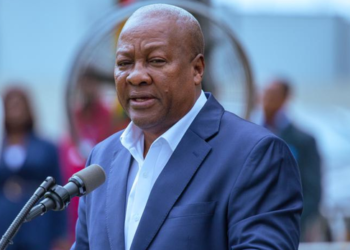
Businessman and economist Dr Kofi Amoah has called on President John Dramani Mahama to initiate investigations into the Ghanaian dimension of the corruption case involving former Tema Oil Refinery (TOR) Managing Director Asante Kwaku Berko.
Dr Amoah said the recent conviction of Mr Berko by a United States federal jury provides Ghana with an opportunity to pursue allegations involving local officials in the bribery scheme connected to a power project.
In a commentary on his verified X account, Dr Amoah urged the President to direct the Attorney-General to examine the evidence arising from the US proceedings and take appropriate action against any Ghanaian officials found to have been involved.
“Have your Attorney General pursue this case,” he said, insisting that Ghana must demonstrate that corruption would have consequences regardless of the political affiliations of those implicated.
The call follows the conviction of Mr Berko in the United States on charges including conspiracy to violate the Foreign Corrupt Practices Act, violating the Act and conspiracy to commit money laundering.
According to the US Department of Justice, Mr Berko, while serving as an Executive Director in Goldman Sachs’ Investment Banking Division, was involved in a transaction concerning a power plant project involving the Government of Ghana and Turkish energy company Aksa Energy.
US prosecutors alleged that Mr Berko and his co-conspirators paid more than US$1 million in bribes to Ghanaian government officials to secure approvals for the project.
The prosecution also alleged that payments were discussed in relation to Ghana’s then Minister of Power, a senior adviser and Members of Parliament who had ratified the agreement.
The US authorities have not, in the latest conviction announcement, publicly identified the Ghanaian officials allegedly connected to the scheme.
It is this unresolved aspect of the case that Dr Amoah believes Ghana must now pursue.
Call for Action Beyond Political Lines
Dr Amoah argued that the conviction had moved the issue beyond allegations and created an opportunity for Ghanaian authorities to examine information emerging from the US judicial process.
He said Ghana had established institutions such as the Economic and Organised Crime Office (EOCO) and the Office of the Special Prosecutor, alongside laws intended to combat corruption, but argued that more needed to be done to translate those mechanisms into effective accountability.
He expressed concern that corruption continued to deprive the country of resources needed for development and placed an unfair burden on ordinary citizens.
Dr Amoah also linked the issue to President Mahama’s anti-corruption agenda and the Operation Recover All Loot (ORAL) initiative.
He argued that the Berko case presented the administration with an opportunity to demonstrate that its anti-corruption campaign would not target only individuals associated with the previous government.
According to him, the allegations arising from the US case should be pursued wherever the evidence leads, including if individuals associated with the current governing party are found to have played a role.
“The people who seem culpable in the ‘dumsor’ corruption judgement by a US court seem to be largely, not exclusively, from the ruling political party,” he said.
Dr Amoah said pursuing such allegations would help establish whether Ghana’s fight against corruption was based on principle rather than political considerations.
‘Corruption Must Never Pay’
The businessman described the circumstances surrounding the conviction as a rare opportunity for Ghana to strengthen its own anti-corruption efforts.
He appealed to President Mahama not to allow the opportunity to pass without a comprehensive examination of the Ghanaian side of the case.
He said the President could use the matter to demonstrate through concrete action that public officials and other individuals connected to corrupt transactions would be held accountable.
“Corruption must never pay, Ghana must act,” Dr Amoah declared.
He further argued that tackling corruption was essential to Ghana’s long-term development, saying resources lost through corrupt practices could otherwise be invested in improving the lives of citizens.
Dr Amoah therefore called for the relevant Ghanaian institutions to follow the evidence contained in the US case and determine whether there were grounds for investigations, prosecutions or other legal action locally.
He said the ultimate test of the government’s anti-corruption commitment would be its willingness to pursue accountability irrespective of political affiliation.
“Luck = Preparation + Opportunity,” he wrote, arguing that the Berko conviction had presented Ghana with an opportunity to act on its long-standing search for stronger accountability.
The development has consequently shifted attention from the conviction of the former Goldman Sachs executive to whether Ghanaian authorities will investigate the alleged local beneficiaries and participants in the bribery scheme, where evidence supports such action.