
















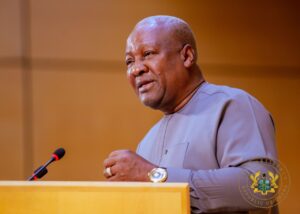
President John Dramani Mahama has announced a GH¢400 million allocation in the 2027 Budget to recruit additional Blue Water Guards as part of intensified efforts to combat illegal mining and protect Ghana’s water bodies.
The funding, announced during a courtesy call by chiefs from the Western North Region, is expected to strengthen surveillance along rivers and other water bodies threatened by illegal mining, popularly known as galamsey.
President Mahama said the government was combining increased enforcement with measures to prevent illegal miners from returning to areas already cleared of their activities.
He disclosed that all nine forest reserves previously designated as red zones because of extensive environmental destruction and the presence of heavily armed illegal miners had been cleared, with soldiers deployed to secure the areas.
“We have now cleared all nine of those red zones. There are no galamsey operators in those forest reserves, and we have stationed soldiers there to ensure that the illegal miners do not return. The soldiers will remain in those areas,” he said.
The President explained that previous operations had failed to achieve lasting results because illegal miners returned to the reserves after military personnel withdrew.
He said forest guards who subsequently resumed responsibility for protecting the areas had come under attack, with some losing their lives.
“Whenever forest guards went there, they were fired upon, and some lost their lives,” he said.
President Mahama said the decision to maintain a military presence in the cleared reserves was intended to prevent a recurrence of the situation and protect the gains made in the fight against illegal mining.
Blue Water Guards to intensify river patrols
As part of the renewed enforcement strategy, the President said Blue Water Guards had been directed to destroy changfang machines used for illegal mining whenever they encountered them during their operations.
He said several machines had already been destroyed, contributing to the clearance of major river channels previously affected by illegal mining.
However, he acknowledged that illegal mining activities along tributaries continued to introduce mud and silt into rivers, undermining efforts to restore the country’s water bodies.
The additional recruitment, he said, would strengthen the government’s capacity to patrol rivers and intensify operations against illegal mining activities.
Mahama seeks chiefs’ support
President Mahama also called on traditional authorities to deepen their collaboration with the government to ensure the sustainability of the anti-galamsey campaign.
He said chiefs and community leaders had an important role to play because of their proximity to local populations and their understanding of the social and economic factors that encouraged illegal mining.
He expressed concern about resistance to operations by the National Inter-Ministerial Coordinating Committee on Illegal Mining (NAIMOS), particularly in communities where some young people and traditional authorities had opposed enforcement activities.
The President urged the chiefs to help build community support for the campaign and discourage activities that threatened forest reserves and water bodies.
He further expressed concern about incidents in which soldiers had discharged firearms during enforcement operations, resulting in deaths.
He said stronger engagement with communities and traditional leaders was necessary to minimise casualties while ensuring that illegal mining operations were brought under control.
Government plans restoration of degraded forests
Beyond enforcement, President Mahama said the government was taking steps to reclaim forest reserves damaged by illegal mining.
He disclosed that Goldbod had begun engaging the military in a programme to restore degraded forest areas and replant them with economic trees.
Under the initiative, bulldozers would be deployed to level destroyed lands, while the Forestry Commission would work with the military to undertake reclamation and reforestation.
The programme is intended to rehabilitate damaged landscapes and restore their environmental and economic value.
President Mahama said the fight against illegal mining must also address the economic conditions driving young people into the activity, stressing the need for measures that went beyond arrests and the destruction of mining equipment.
He maintained that sustained cooperation between the government, traditional authorities and local communities would be essential to protecting the country’s forests and rivers from further degradation.






