
















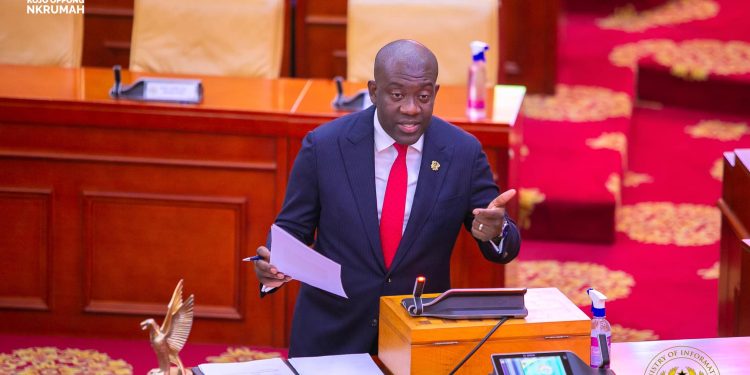
The New Patriotic Party (NPP) is calling for the establishment of a formal consultative or constituent assembly to deliberate on proposed changes to Ghana’s 1992 Constitution before the government proceeds with the amendment process.
The party says the breadth of the proposed changes requires a broader national deliberative process involving political parties, organised labour, professional associations and other key stakeholders.
NPP Policy Committee Chairman and Ofoase/Ayirebi MP, Kojo Oppong Nkrumah, made the call at a press briefing on Thursday, September 17, 2026.
He said the Constitution Review Committee’s recommendations cover 147 of the Constitution’s 299 articles, alongside 59 new provisions.
Mr Oppong Nkrumah argued that the number and scope of the proposed changes extend across the Executive, Legislature, independent constitutional bodies and local government, making the exercise substantially broader than a routine amendment.
“Amendment of 147 of 299 articles, together with 59 new provisions, that is 206 reaching into the executive, the legislature, independent constitutional bodies, and local government, is not just an adjustment to some provisions of the constitution,” he said.
He said the NPP was particularly concerned about what it described as differences between the government’s position and the recommendations of the Constitution Review Committee.
According to him, the government has adopted positions that differ from about 100 of the 147 recommendations submitted by the committee.
He further claimed that the consultation process had been declared closed and that an implementation committee had been directed to proceed with drafting proposals, with November 2026 set as the target for the first amendment.
Mr Oppong Nkrumah said such an approach did not provide sufficient opportunity for stakeholders to deliberate on areas of disagreement before the proposals were translated into legislation.
He therefore called on the government to introduce a Constituent or Consultative Assembly Bill in Parliament to provide a formal framework for broader deliberations.
The former Information Minister said the proposed assembly would offer an avenue for political parties, organised labour, professional bodies and other identifiable groups to examine the recommendations and help resolve outstanding differences.
He cited Ghana’s constitutional experiences in 1969, 1979 and 1992, saying those processes involved expert work followed by deliberation through broad-based representative bodies before constitutional proposals were given legal effect.
“First, the work of an expert deliberated and settled upon by a broad and representative assembly and only then given the force of law,” he said.
Mr Oppong Nkrumah said the NPP was therefore rejecting the current approach to the constitutional review and was urging the government to adopt a more inclusive deliberative mechanism.
The party maintained that the proposed consultative process would provide an opportunity to address the outstanding areas of disagreement and build wider stakeholder participation before Parliament considers the proposed constitutional changes.






