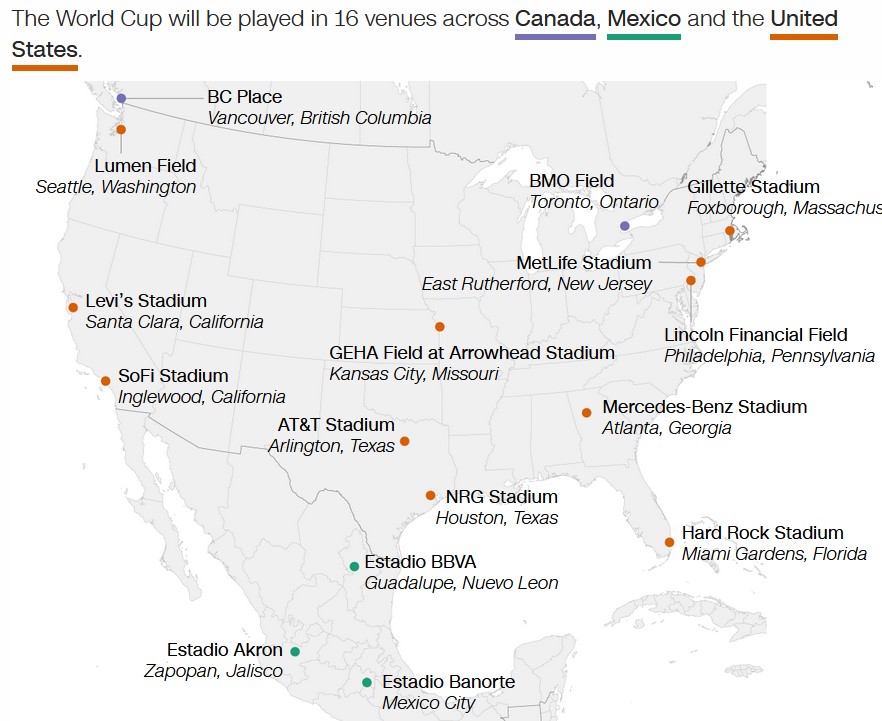
Football fans around the world now have a clear picture of the road to the 2026 FIFA World Cup after the official match schedule was released, detailing group-stage fixtures, venues, and kick-off times for all qualified nations.
The tournament, set to be hosted across the United States, Canada, and Mexico, will feature packed group-stage action beginning in June, followed by knockout rounds leading to the final on July 19 at MetLife Stadium in New Jersey.
Group-stage highlights
Host nations will kick off the tournament with key fixtures spread across major cities:
- The United States will open Group D action in Los Angeles against Paraguay, before facing Australia in Seattle and Turkey again in Los Angeles.
- Mexico will begin its campaign at home in Mexico City against South Africa, followed by matches in Guadalajara and a return to Mexico City.
- Canada will host Bosnia and Herzegovina in Toronto before matches in Vancouver against Qatar and Switzerland.
Several heavyweight clashes are also lined up in the group phase:
- Brazil will face Morocco, Haiti, and Scotland across New York/New Jersey, Philadelphia, and Miami.
- Germany will meet Curaçao, Ivory Coast, and Ecuador in Houston, Toronto, and New York/New Jersey.
- Argentina will take on Algeria, Austria, and Jordan in Kansas City and Dallas.
European and African sides also feature in tightly contested groups, with England drawn against Croatia, Ghana, and Panama, while France will face Senegal, Iraq, and Norway.
Knockout path mapped out
The tournament progresses into the Round of 32 from June 28, followed by the Round of 16 in early July. Quarterfinal matches will be staged in Foxborough, Los Angeles, Miami Gardens, and Kansas City.
The semifinals are scheduled for July 14 and 15 in Texas and Atlanta, while the third-place playoff will be held in Miami Gardens on July 18.
Final showdown in New Jersey
The World Cup final will take place on July 19 at MetLife Stadium, marking the climax of the expanded tournament format.
With matches spread across 16 host cities, fans are now able to plan travel and follow their teams’ journeys through what is expected to be the largest and most geographically diverse World Cup in history.