
















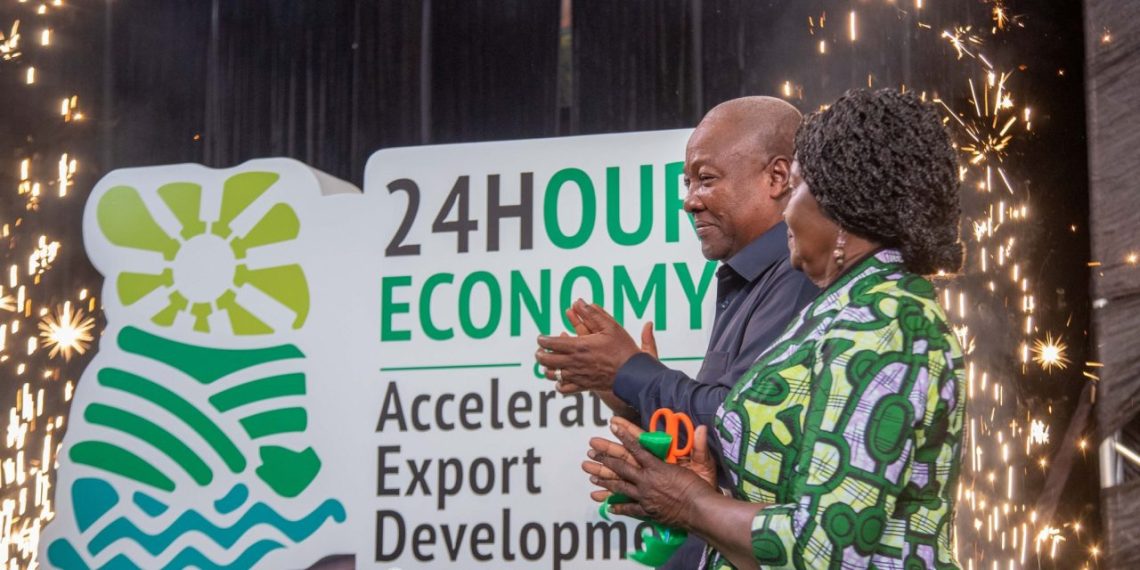
The Secretariat of the 24-Hour Economy programme has defended the government’s flagship economic policy against criticism, insisting that the initiative is already attracting billions of dollars in investment and creating the foundation for large-scale job creation.
Responding to concerns raised by the Ranking Member of Parliament’s Economy and Development Committee, Kojo Oppong Nkrumah, the Secretariat said the programme had progressed beyond the planning stage and was already delivering measurable outcomes through private-sector partnerships.
According to the Secretariat, Joint Development Agreements worth US$5.5 billion had been secured with co-development partners as of May 2026, while 268 filling stations and 33 manufacturing companies had begun operating under the programme’s multi-shift production model.
It maintained that the success of the initiative should not be judged by government expenditure but by its ability to mobilise private investment, expand production, boost exports and generate employment.
“The right measure is the investment the Programme mobilises and the production, exports and jobs it generates,” the Secretariat said.
The Secretariat disclosed that the programme aims to create 1.7 million decent jobs by the end of 2028, noting that four agreements signed within the last 90 days alone are expected to generate more than 160,000 direct jobs.
It also dismissed suggestions that the programme had spent part of the GH¢650 billion approved by Parliament over the past two years, explaining that the amount represented the country’s total budget allocation for all government programmes and not expenditure on the 24-Hour Economy initiative.
“The GH¢650 billion cited by Hon. Oppong Nkrumah is the total that Parliament has appropriated for all government programmes over the past two years. It is by no means the expenditure made by or on the 24-Hour Economy,” the statement said.
The Secretariat stressed that the programme is largely driven by private-sector investment, with both local and international companies expected to finance the majority of projects, while government’s role is limited to project preparation, coordination and viability gap support.
Among the flagship projects highlighted was the US$1.45 billion Buipe Solar and Battery Project, expected to generate 1,500 megawatts of electricity and create approximately 13,000 jobs.
It also cited the US$250 million Kambonwule Oil Palm Complex, which is projected to create about 120,000 jobs when fully operational.
The Secretariat further noted that several public institutions, including the Driver and Vehicle Licensing Authority (DVLA), the Ghana Publishing Company and the Ghana Ports and Harbours Authority (GPHA), had already begun offering 24-hour services under the policy.
According to the Secretariat, the phased implementation of the programme is intended to ensure that projects are backed by credible investors while addressing key challenges such as land acquisition, infrastructure and reliable electricity supply.
It expressed confidence that the benefits of the policy would become more evident in the coming months through increased industrial production, expanded exports, new investments and sustainable job creation across the country.






