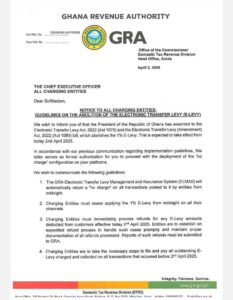
The Ghana Revenue Authority (GRA) has officially announced the abolition of the 1% Electronic Transfer Levy (E-Levy), effective today, following the presidential assent to the Electronic Transfer Levy Act, 2022 (Act 1075) and its Amendment Act, 2022 (Act 1089).
In a formal notice addressed to all charging entities, the GRA confirmed that the Electronic Transfer Levy Management and Assurance System (ELMAS) has been configured to automatically return a “no charge” status on all electronic transactions moving forward. Charging entities have been instructed to immediately cease applying the E-Levy on all their platforms from midnight, April 2, 2025.
Additionally, the GRA has mandated that all charging entities process refunds for any E-Levy deductions made on transactions occurring today. Entities must establish an expedited process for handling these refunds and maintain proper documentation of all transactions. Reports of these refunds must be submitted to the GRA for accountability.
Furthermore, the GRA has directed all charging entities to ensure they file and settle any outstanding E-Levy payments related to transactions that occurred before April 2, 2025.
The abolition of the E-Levy marks a significant policy shift in Ghana’s tax regime. Introduced in 2022, the levy was a contentious subject, drawing criticism from the public and business community over concerns of double taxation and financial strain on digital transactions. The government’s decision to repeal the levy is expected to encourage greater participation in digital financial services and ease the cost burden on individuals and businesses.
This latest development underscores the government’s commitment to reforming Ghana’s tax landscape and fostering a more inclusive digital economy. The GRA has urged all charging entities to comply with the new directive and ensure a smooth transition in line with the updated regulations.