
















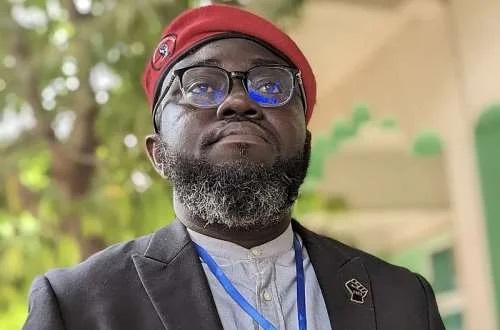
Lawyer and governance activist Oliver Barker-Vormawor has returned to Ghana’s constitutional reform process more than a decade after contributing to the review of the 1992 Constitution, this time as Secretary and member of the 11-member Constitution Review Implementation Committee (CRIC).
His appointment places him at the centre of the next phase of the reform process, which seeks to move beyond recommendations and establish practical measures for implementing proposals accepted by government.
The committee was inaugurated on Friday, August 28, by Attorney-General and Minister of Justice Dominic Akuritinga Ayine and is chaired by Presidential Legal Counsel and former Attorney-General Marietta Brew Appiah-Oppong.
The CRIC has been tasked with translating approved constitutional reform proposals into concrete legislative, administrative and, where required, referendum measures.
Among its responsibilities are the preparation of an implementation roadmap, a legislative and referendum calendar, as well as mechanisms for monitoring progress on each accepted recommendation.
For Barker-Vormawor, the appointment represents a return to a constitutional process with which he has been associated since his early professional career.
Between January 2010 and December 2011, he served as a Constitutional Researcher and Access to Justice Advisor to the Constitution Review Commission, which examined the strengths and weaknesses of the 1992 Constitution and subsequently proposed reforms.
His contribution to that exercise earned him recognition for what was described as “Extra-Ordinary Services as Researcher to the Constitution Review Commission.”
More than a decade later, he is again participating in the constitutional reform process, but from a role focused on implementation rather than the initial review of the Constitution.
Barker-Vormawor, 39, is also recognised for his involvement in the #FixTheCountry movement, which has campaigned for greater accountability, stronger institutions and systemic reforms in Ghana.
His professional background spans law, governance, diplomacy and international affairs. He previously served in Ghana’s Foreign Service, worked as a Senior Legal and Policy Officer at the Office of the President and was a Judicial Fellow to the Vice President of the International Court of Justice.
He has also worked with the United Nations Headquarters in New York and international law firm Covington & Burling in Washington, DC, while providing consultancy services to organisations including the World Bank, UNDP, DFID, OSIWA and ClientEarth.
He is currently pursuing a PhD at the University of Cambridge’s Faculty of Law, with research focusing on global governance and international law, particularly the participation of developing countries in global governance frameworks.
Reacting to his appointment, Barker-Vormawor described constitutional reform as a long-term commitment rather than a short-term assignment.
He said his interest in the subject began about 17 years ago when, at the age of 22, he joined the Constitution Review Commission as one of its youngest research leads.
“Since then I have remained convinced of the centrality of constitutional reform to fulfilling Ghana’s mission,” he said.
He cautioned, however, that the current implementation process should not be mistaken for the conclusion of the broader constitutional reform agenda.
According to him, political consensus on some fundamental constitutional changes remains lacking, meaning the wider campaign for reform must continue.
He indicated that his work with Democracy Hub would also continue alongside his responsibilities on the CRIC.
“My colleagues at Democracy Hub consider this as just the beginning of their long-standing campaign and not the end. I subscribe to that creed; and our advocacy continues,” he said.
Barker-Vormawor’s return to the constitutional reform process comes at a critical stage, as government shifts its attention from examining recommendations to determining which proposals can be translated into law, policy and institutional practice.
His dual experience as a former constitutional review researcher and contemporary governance activist could therefore bring a distinctive perspective to the committee as it works to turn approved reform proposals into actionable measures.






