
















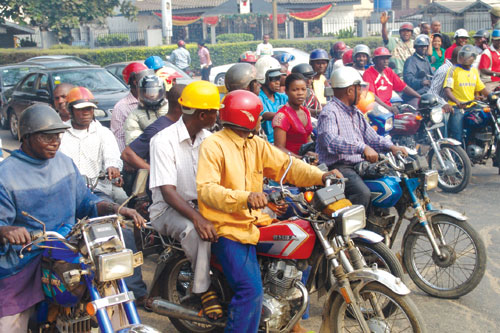
The government is preparing to enforce stricter compliance with road safety regulations as Ghana moves to formally integrate commercial motorcycles, tricycles and quadricycles into the transport system.
Transport Minister Joseph Bukari Nikpe said the formalisation of the operations would not mean a relaxation of road traffic rules, stressing that operators would be required to meet safety and accountability standards under the new legal framework.
He said the implementation of the Road Traffic (Amendment) Act, 2025 (Act 1153) and the Road Traffic Regulations, 2026 (L.I. 2519) was intended to bring greater discipline and accountability to the country’s road transport sector.
Mr Nikpe made the remarks in an interview with the Ghana News Agency on the sidelines of a national dissemination and sensitisation programme on the new legislation in Accra.
He said the Ministry would embark on a nationwide public education campaign to ensure drivers, commercial transport operators, pedestrians and other road users understood the new requirements and their responsibilities.
“We want every driver, road user, and person who is in the transport industry to understand clearly what this law means and also how it is going to be operationalised,” he said.
‘Okada’ riders to face safety requirements
Mr Nikpe said the government had engaged commercial motorcycle rider associations and would include them in the nationwide sensitisation programme.
He said some representatives of the riders had been taken to Rwanda to study how commercial motorcycle operations were regulated and managed.
According to him, commercial motorcycles could help bridge transportation gaps, particularly in communities where conventional public transport was unavailable or unable to provide effective last-mile services.
He said the same applied to tricycles and quadricycles, which could also support the movement of goods and people, including connecting farms and production centres to markets.
However, the Minister stressed that the new opportunities came with responsibilities.
Operators, he said, would be required to understand and comply with traffic signs, road rules, designated stopping points and other safety requirements.
Stronger tracking of vehicles
The new regulations would also strengthen the ability of law enforcement agencies to trace vehicles and their owners, Mr Nikpe said.
He explained that changes to the registration and number plate system would link number plates to vehicle owners rather than simply to vehicles.
That, he said, would make it easier for authorities to identify vehicle owners when their vehicles were involved in traffic offences or other criminal activities.
Technology would also play an increasing role in enforcement, with the Police expected to deploy surveillance systems along roads, as well as specialised vehicles and motorcycles, to detect violations and identify offenders.
Lower alcohol limit, driving age
Mr Nikpe said the reforms also introduced changes intended to improve road safety while broadening participation in the transport sector.
The government had reduced the permissible alcohol concentration for drivers and lowered the minimum driving age from 25 to 21 years.
He said the Ministry was working with the Ministry of the Interior, Ministry of Roads and Highways, Driver and Vehicle Licensing Authority (DVLA), National Road Safety Authority (NRSA) and the Ghana Police Service to ensure coordinated implementation of the new framework.
Minister warns pedestrians
The Transport Minister also urged pedestrians and motorists to exercise greater caution, particularly around pedestrian crossings and highways.
He advised pedestrians to use designated crossing points instead of attempting to cross busy highways at unsafe locations.
“If you are on a highway and you want to run across, you think you are smart, you cannot be faster than a machine,” he cautioned.
Mr Nikpe said the government’s broader objective was to create a road transport system that was safer, more orderly and responsive to the country’s changing mobility and economic needs.
He therefore appealed to road users to cooperate with enforcement agencies and take the new regulations seriously.






