
















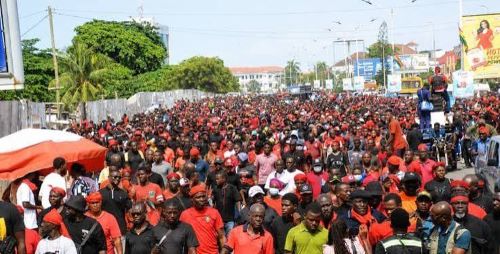
Minority Leader Alexander Afenyo-Markin has called on Ghana’s political leadership to reject a cycle of retaliation and ensure that justice is applied fairly, warning that selective enforcement of the law could weaken the country’s democratic foundations.
Addressing supporters during the New Patriotic Party’s (NPP) “Democracy Under Attack” protest on Thursday, August 6, the Effutu Member of Parliament said the opposition party was not opposed to accountability but would resist what it perceives as politically motivated actions by state institutions.
“We are not against accountability, but we are against selective justice,” Mr Afenyo-Markin stated.
He argued that democracy is endangered when public institutions are perceived as being used to target political opponents, adding that political disagreements must not translate into intimidation or harassment.
The Minority Leader raised concerns about lawmakers becoming subjects of investigations by state agencies over comments made during parliamentary proceedings, cautioning that such developments could affect the independence and privileges of Parliament.
He also referred to concerns raised by former Minority Leader Haruna Iddrisu and Interior Minister Muntaka Mohammed-Mubarak regarding the treatment of some persons in custody, urging that the rights of all citizens be respected.
Mr Afenyo-Markin maintained that criticism of government policies and decisions is an essential feature of democratic governance and should not be treated as an act of hostility.
He appealed to political actors to move away from what he described as “an eye for an eye” politics, stressing that Ghana’s democracy must be built on tolerance, fairness and respect for institutions.
According to him, his concerns were not limited to members of the NPP but reflected a broader commitment to ensuring that political disputes are handled through democratic means.
The Minority Leader urged political leaders to focus attention on addressing challenges confronting citizens, particularly people living in deprived communities.
“When you travel beyond Accra into the hinterlands, you see the level of underdevelopment. That should be the priority of political leaders,” he said.
He further warned that perceptions of political persecution could deepen divisions and make it increasingly difficult for moderate voices within political parties to encourage restraint among supporters.
“For me, if this continues, it will become difficult for moderates in the NPP to calm the nerves of those who may feel pushed to the extreme when the party returns to power. Is that the kind of country we want? No,” he said.
Mr Afenyo-Markin concluded that the demonstration was not aimed at undermining Ghana’s democratic system but rather a call for fairness, justice and the protection of constitutional freedoms.






