
















The government has approved a revised Minerals and Mining Policy and reviewed the country’s mining law as part of efforts to increase Ghanaian participation, promote value addition and strengthen regulation in the mining sector.
The Minister for Lands and Natural Resources, Emmanuel Armah-Kofi Buah, announced that Cabinet had endorsed the revised Minerals and Mining Policy of 2014, alongside amendments to the Minerals and Mining Act, 2006 (Act 703), which will now be presented to Parliament for approval.
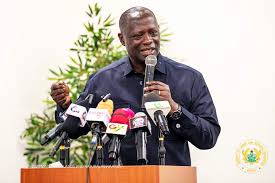
Speaking at the Government Accountability Series press conference at the Presidency on Wednesday, Mr. Buah said the reforms are designed to ensure that Ghana derives greater economic benefits from its mineral resources while addressing challenges such as illegal mining and environmental degradation.
He explained that the revised policy seeks to deepen local content participation by promoting domestic ownership, mineral processing, stronger links between mining and manufacturing, and greater involvement of Ghanaian businesses across the mining value chain.
“The policy seeks to indigenise mining by strengthening local content and participation through domestic value addition to minerals, improve linkages to the manufacturing industry and deal decisively with the menace of illegal mining and protection of the environment,” he said.
According to the Minister, the proposed amendments to Act 703 provide a more modern legal framework that reflects current realities in the mining industry and positions the sector to contribute more significantly to national development.
Among the key changes is the introduction of district mining committees to serve as the entry point for mineral licensing, the creation of medium-scale mining as a distinct category and the replacement of reconnaissance and prospecting licences with a single exploration licence capped at five years.
The revised legislation also reduces the maximum duration of mining leases from 30 years to 20 years and introduces mandatory Community Development Agreements between mining companies and host communities.
Mr. Buah said the new arrangements are expected to ensure that communities directly affected by mining activities have a stronger voice in determining development priorities.
He also highlighted the passage of the Minerals and Mining (Royalties) Regulations, 2025 (L.I. 2517), describing it as a major step towards creating a more flexible royalty system.
Under the new royalty regime, payments will adjust according to commodity prices and production levels, allowing government to benefit more during periods of high mineral prices while reducing pressure on mining companies during market downturns.
The Minister said the government’s broader vision is to transform Ghana’s mining industry from one focused largely on raw mineral exports into an industry driven by processing, manufacturing, innovation and local enterprise development.
“Our vision for Local Content is to ensure that Ghana’s mineral wealth creates lasting prosperity for Ghanaians. We are committed to building a mining industry where our people are not merely participants, but owners, investors, innovators, and manufacturers,” he said.
Mr. Buah noted that the government’s commitment to local participation informed the organisation of the maiden Mining Local Content Summit in Takoradi earlier this year, which brought together stakeholders to promote value addition and industrialisation.
He stressed that government would continue to protect genuine Ghanaian participation in the sector and would not allow fronting or other arrangements that undermine the objectives of the local content policy.






