
















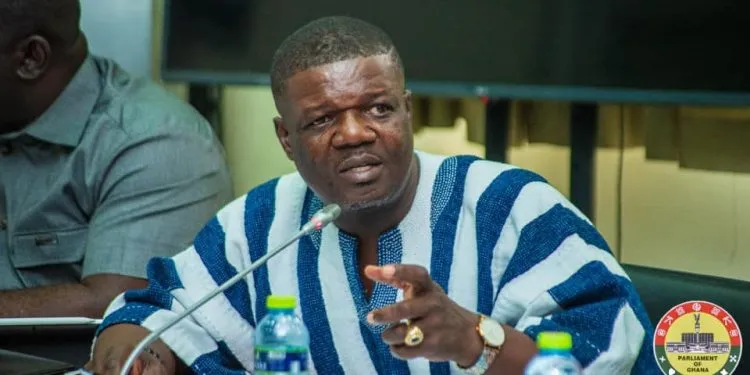
Majority Chief Whip and South Dayi MP, Rockson-Nelson Dafeamekpor, has questioned the International Monetary Fund’s (IMF) criticism of political appointments to the boards and leadership of Ghana’s state-owned enterprises (SOEs).
Mr Dafeamekpor argued that the practice was not unique to the National Democratic Congress (NDC), insisting that previous New Patriotic Party (NPP) administrations also appointed senior party figures and politicians to key state institutions.
His comments follow an IMF Technical Assistance Report which identified the continued politicisation and centralisation of SOE appointments as a major weakness in Ghana’s governance framework.
The report said that despite efforts to establish more merit-based appointment procedures, appointments to SOEs remained “highly political and centralised in the Presidency.”
It further observed that boards of major state enterprises were often dominated by political appointees, with ministers, Members of Parliament and senior party officials frequently serving as board chairpersons.
Dafeamekpor cites NPP appointments
Reacting to the IMF assessment on X, Mr Dafeamekpor challenged the Fund to apply the same scrutiny to both major political parties.
He cited the appointment of former NPP National Chairman Peter Mac Manu as Board Chairman of the Ghana Ports and Harbours Authority (GPHA) and former NPP Minister Hackman Owusu-Agyemang as Board Chairman of the Ghana Cocoa Board (COCOBOD) under the Akufo-Addo administration.
“So what exactly do these IMF Country Directors want from the NDC anytime we are in Govt?” he asked.
The South Dayi MP said he was prepared to provide a list of NPP national executives and MPs who served on boards of state-owned enterprises between 2017 and 2024, as well as during the NPP administration from 2001 to 2008.
His argument was that criticism of political appointments should recognise the longstanding nature of the practice rather than being interpreted as a problem associated with only NDC administrations.
Calls for impartial assessment
Mr Dafeamekpor also questioned what he described as the IMF’s neutrality in Ghana’s political discourse.
He linked his concerns to an earlier IMF report on Ghana’s gold-related operations, suggesting that the Fund’s recent assessments raised questions about the consistency of its approach to issues involving the government.
The IMF, however, has recommended reforms aimed at reducing political influence in the management of SOEs.
It has called for more transparent and merit-based procedures for appointing board members and chief executives, alongside measures to gradually reduce the number of active politicians and senior government officials serving on the boards of strategically important state enterprises.
According to the Fund, stronger board independence would improve oversight, accountability and the financial sustainability of Ghana’s SOE sector.






