
















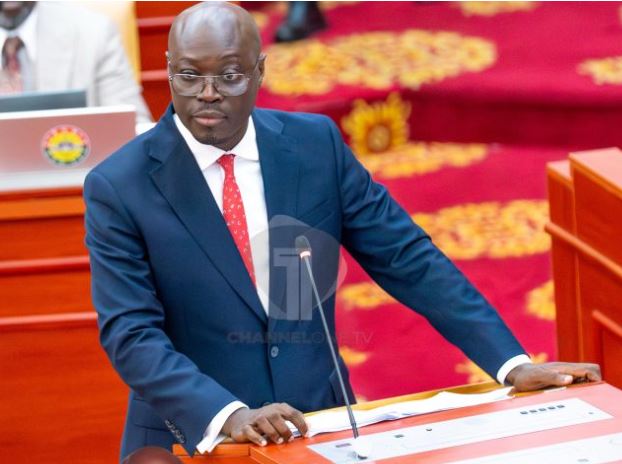
Finance Minister Dr. Cassiel Ato Forson has ruled out any possibility of using public funds to recapitalise the Bank of Ghana (BoG), stressing that the central bank must find internal solutions to its financial woes.
Speaking on Joy News on Tuesday, March 11, after presenting the 2025 Budget Statement to Parliament, Dr. Forson responded to reports that the previous Ernest Addison-led administration had signed a memorandum of understanding (MoU) for a ¢53 billion bailout to stabilize BoG’s finances. He made it clear that the government would not burden taxpayers with this obligation.
### **BoG’s Financial Struggles and Negative Equity**
Dr. Forson highlighted concerns over BoG’s financial health, recalling his warnings about the institution’s growing deficit and negative equity during his tenure as Minority Leader. “On the back of the report that showed the ¢60 billion hole, I repeatedly cautioned that the Bank of Ghana was accumulating unsustainable debt. Today, we see the reality—its balance sheet is in poor shape,” he noted.
Despite the dire financial situation, the Finance Minister firmly stated that BoG must take responsibility for its own recovery. “They have to look within. The taxpayer cannot afford ¢53 billion to bail out the central bank,” he insisted.
### **Cutting Costs and Selling Non-Essential Assets**
Dr. Forson advised BoG to explore cost-cutting measures and asset sales to rebuild its financial stability. He pointed to the bank’s newly constructed headquarters as a potential source of funds. “They have a choice—to sell and lease back if they want. They must cut unnecessary expenditures and reduce events,” he said.
Additionally, he suggested selling off non-essential BoG properties, including guest houses and hotels, to generate capital. “Why is the Bank of Ghana in the guest house business? They should sell some of these assets and use the money to recapitalise. The taxpayer cannot continue to be a punching bag,” he stressed.
### **Government Prioritizing Essential Public Services**
The Finance Minister made it clear that diverting ¢53 billion to BoG would come at the expense of critical national projects. “If we allocate such an amount to the central bank, it means we will have to deny taxpayers essential services like roads, schools, and hospitals. Is that a trade-off we can afford? The answer is no,” he stated.
### **Long-Term Strategy for BoG’s Recovery**
While rejecting an immediate bailout, Dr. Forson left room for discussions on a long-term strategy for BoG’s financial recovery. “If the central bank comes up with a reasonable proposal, we can have a conversation. But they must take the first step,” he said.
He also proposed a gradual recapitalisation approach, suggesting that BoG could reinvest its profits over the next decade. “They may have to consider winding back their profits over the next 10 years to rebuild their capital base,” he noted.
Dr. Forson’s stance signals a firm commitment to fiscal discipline while pushing BoG to adopt internal reforms rather than relying on government intervention.






