
















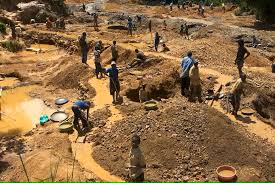
Ghana’s fight against illegal mining has taken a sharper national security dimension, with authorities warning that the growing presence of weapons and environmental destruction at galamsey sites poses a direct threat to the country’s stability.
At a press briefing in Accra, Colonel Eric Amponsah Buah, Coordinator of the National Anti-Illegal Mining Operations Secretariat (NAIMOS), described illegal miners as “the number one enemy of the state,” stressing that enforcement operations would be intensified across the country.
He revealed that beyond environmental damage, the proliferation of firearms at illegal mining sites had significantly heightened the risk of violent confrontations.
“There are several weapons in the space… and that is a huge risk because any provocation can trigger violence,” he cautioned, adding that security personnel would respond decisively in self-defence when threatened.
The warning comes amid expanded operations targeting major river bodies, including the Ankobra and Pra, where illegal mining has severely polluted water sources and disrupted livelihoods.
According to NAIMOS, the ongoing operations are intelligence-driven, relying on tip-offs from local communities, traditional leaders and civil society groups, alongside collaboration with the Ghana Armed Forces, Police Service and National Intelligence Bureau.
Authorities say the crackdown has already led to the seizure of excavators, weapons and other equipment, all of which remain in state custody pending further action.
Col. Buah also disclosed that foreign nationals involved in illegal mining had been arrested, processed and deported, with many subsequently blacklisted from re-entering the country.
While enforcement remains a priority, NAIMOS says it is equally focused on environmental recovery. Reclamation works are currently underway in degraded areas, including more than 800 acres of land at Manso-Nkwanta in the Ashanti Region.
The Secretariat has also begun permanent deployments in key hotspots, signaling a shift from periodic interventions to sustained presence on the ground.
Despite these efforts, officials warn that the long-term success of the campaign depends heavily on public cooperation.
“We want to ask ourselves, don’t we know we are killing ourselves?” Col. Buah said, urging citizens and the media to actively support the fight through credible information sharing.
He further called on illegal miners to abandon their activities and take advantage of planned cooperative mining schemes, warning that continued defiance would attract strict sanctions.
With water pollution worsening and illegal mining increasingly linked to organised criminal activity, authorities say the battle against galamsey is no longer just an environmental issue—but a critical fight for national survival.






