
















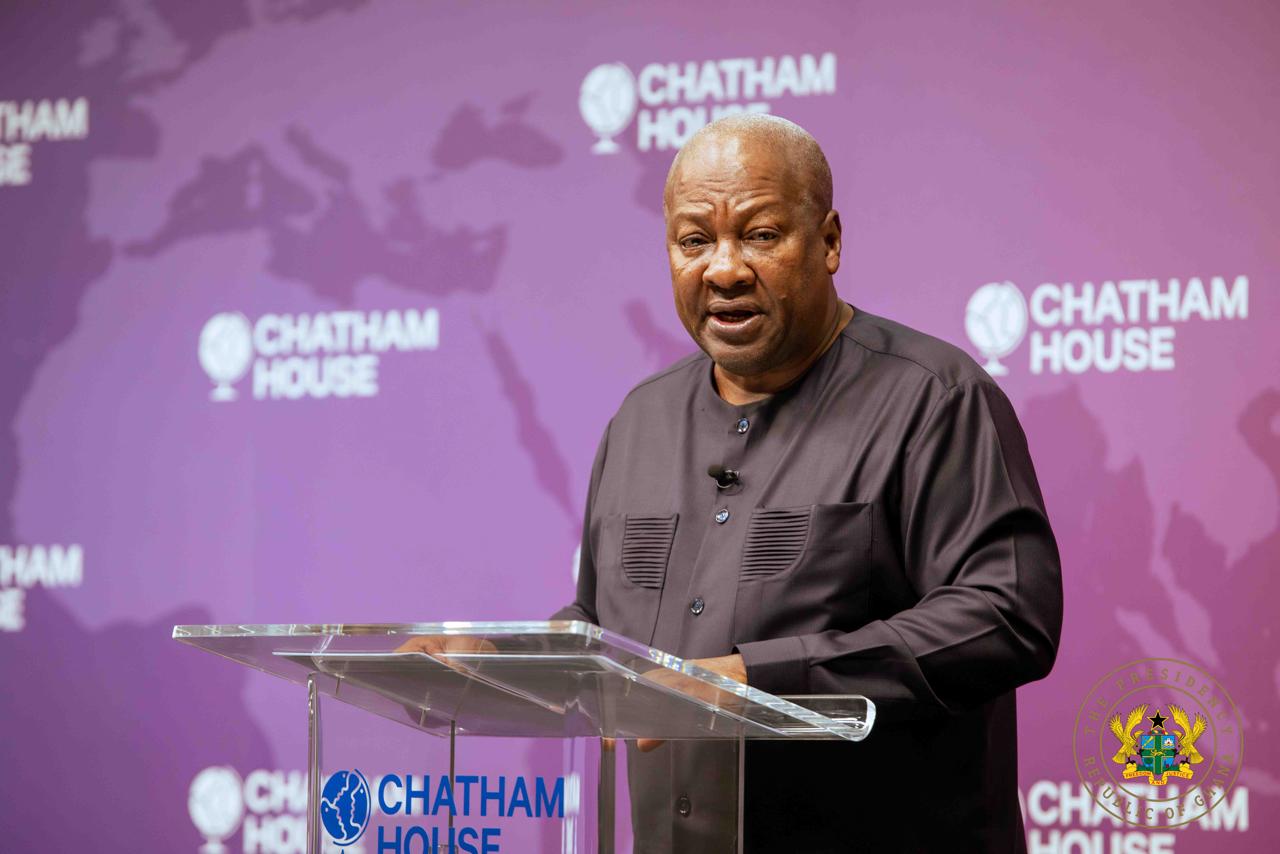
President John Dramani Mahama has insisted that Ghana’s diplomatic relationship with South Africa remains intact despite recent xenophobic attacks that have forced hundreds of Ghanaians to seek evacuation from the country.
Speaking at Chatham House in London during his official visit to the United Kingdom, President Mahama described the attacks on foreign nationals as unfortunate but stressed that they had not affected the longstanding relations between the two countries.
He acknowledged growing concerns over anti-foreign violence in South Africa, noting that while previous incidents largely targeted nationals from neighbouring countries, recent attacks have increasingly affected Ghanaians living and working there.
According to the President, deteriorating security conditions and attacks on foreign-owned businesses prompted the government to organise voluntary evacuation flights for citizens who no longer felt safe.
He revealed that many displaced Ghanaians sought refuge at Ghana’s High Commission in Pretoria, with nearly 200 people reportedly taking shelter at the mission at one point.
President Mahama said the government decided to intervene after concerns mounted over the safety of Ghanaian nationals and the slow pace of efforts to restore calm in affected areas.
He disclosed that the first evacuation flight had already brought home 300 Ghanaians, while additional flights were being planned for those who wished to return voluntarily.
Beyond the immediate crisis, the President called for a deeper examination of the economic and social factors driving recurring outbreaks of anti-foreign sentiment in South Africa.
He argued that migration plays a vital role in economic development across Africa and that foreign nationals contribute skills, investments and entrepreneurship to host countries.
President Mahama urged African leaders to work together to address unemployment and inequality, particularly among vulnerable communities, while challenging perceptions that migrants are responsible for economic hardships.
He maintained that stronger continental cooperation and greater acceptance of cross-border migration would be essential to advancing African integration and shared prosperity.






