
















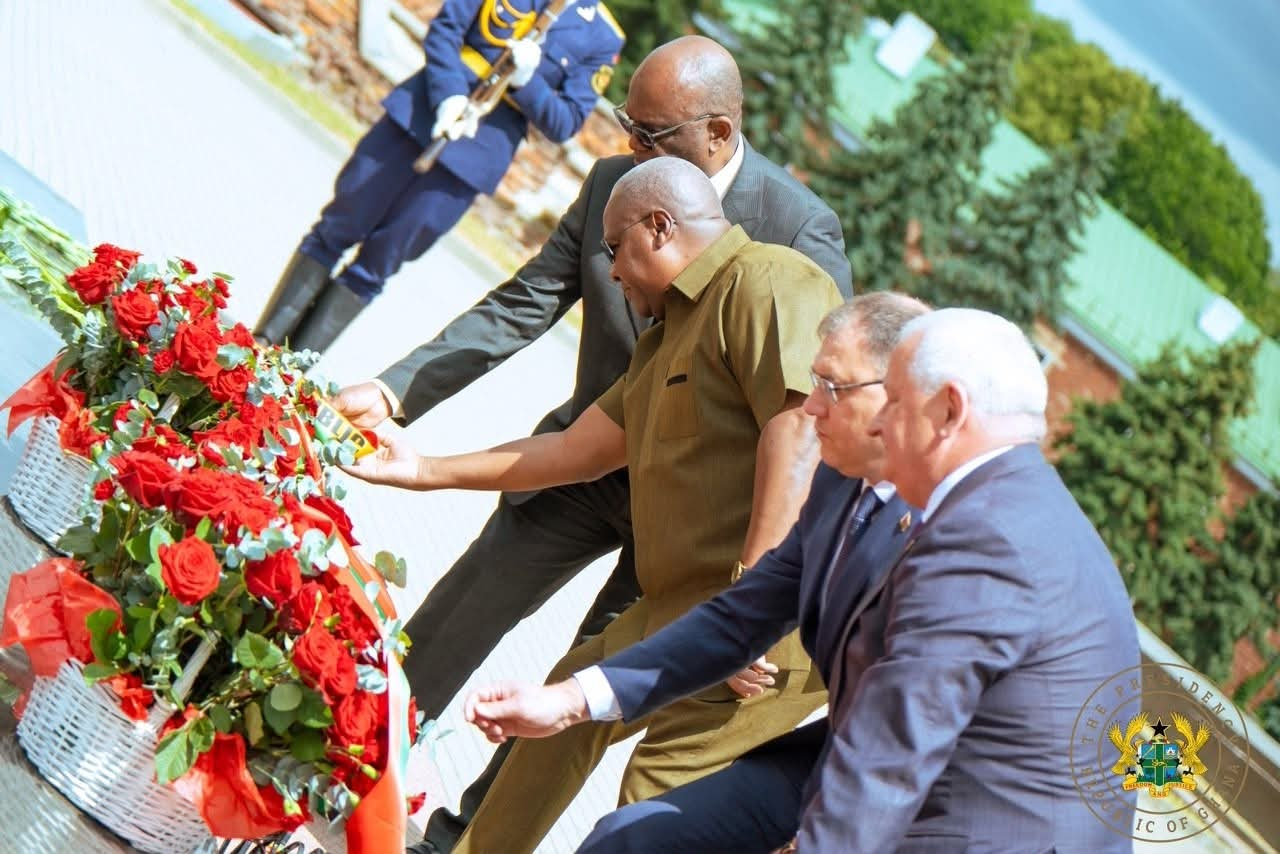
President John Dramani Mahama has concluded a visit to the Brest Hero Fortress Memorial Complex in Belarus, using the historic site as a moment of reflection on resilience, sacrifice, and expanding diplomatic and economic ties between Ghana and Belarus.
The President laid a wreath at the memorial complex in honour of soldiers and civilians who defended the city during the Nazi invasion of 1941, one of the earliest and most intense battles on the Eastern Front of the Second World War.
A statement from the Presidency said President Mahama was accompanied by Ghana’s Ambassador to Russia, Dr Koma Steem Jehu-Appiah; Presidential Advisor and Special Aide, Mrs Joyce Bawa Mogtari; officials from the Belarusian Ministry of Foreign Affairs; and members of the Ghana diplomatic mission in Moscow.
During the visit, the delegation toured the fortress, which sits near the border with Poland and is regarded as one of Belarus’ most important WWII heritage sites. It was among the first locations attacked on June 22, 1941, shortly after the launch of the Nazi invasion of the then Soviet Union.
Governor of Brest, Piotr Alexsandrovich, briefed the President on the historical significance of the site, noting that it remains a national symbol of resistance and remembrance, attracting more than 120,000 visitors in 2025 alone.
President Mahama, who has a background in history, expressed admiration for the endurance shown by defenders of the fortress, describing their resistance as a defining moment in Belarusian national identity.
He noted that despite severe shortages of food, water, and ammunition, Soviet soldiers and civilians held their ground for weeks, an act of defiance that has since become emblematic of the “no step back” spirit associated with the site.
The fortress today preserves wartime ruins, including damaged barracks, gates, and a church, alongside artefacts such as weapons, personal letters, and belongings of those who fought in the defence. It continues to serve as a powerful global symbol of wartime sacrifice and resilience.
Following the tour, President Mahama attended a luncheon hosted in his honour, where he described the visit as a meaningful opportunity to strengthen bilateral relations between Ghana and Belarus.
He observed that the historical resilience associated with Brest also reflects the city’s modern progress in industrialisation, production, and cultural development.
President Mahama expressed Ghana’s interest in deepening cooperation with Belarus, particularly in agriculture, mining, and manufacturing, adding that both countries stand to benefit from expanded economic engagement.
He also extended an invitation to Belarusian investors to explore opportunities in Ghana, expressing optimism that the visit would help reinforce long-term friendship and mutually beneficial partnerships between the two nations.






