
















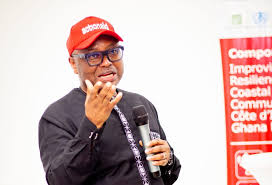
Communities along Ghana’s coastline are facing an existential threat from the ocean, with families losing homes, livelihoods, and ancestral lands to rising seas and tidal waves. In response, a new $2.74 million project has been launched to help protect the most vulnerable.
The initiative—“Improving Resilience of Coastal Communities in Côte d’Ivoire and Ghana”—was inaugurated in Anloga in the Volta Region and is funded by the Adaptation Fund. It brings together ActionAid Ghana, UN-Habitat, Habitat for Humanity International, and the University of Twente.
For communities like Fuvemeh, where up to eight metres of land vanish each year, and in Keta and Anloga, where more than 4,000 residents were displaced in 2021, the project offers a lifeline. According to the Environmental Protection Agency, 37 percent of Ghana’s coastline is already under severe threat, while NADMO warns that unchecked sea level rise could force 1.2 million people from their homes in the coming years.
“This is not just about statistics; it is about people,” said John Nkaw, Country Director of ActionAid Ghana. “Women, children, and persons with disabilities are disproportionately affected, and it is our duty to protect their lives and livelihoods.”
Over the next 18 months, 11 high-risk coastal communities across Greater Accra and the Volta Region—including Woe, Dzita, Agorkedzi, Whutti, and Goi—will benefit from interventions focused on three pillars:
-
Early warning systems to improve preparedness.
-
Nature-based solutions like mangrove restoration to act as natural shields.
-
Climate-resilient livelihoods to provide sustainable income opportunities for women, youth, and farmers.
UN-Habitat’s Regional Project Coordinator, Mouhamadu Diene, stressed that success would depend on the communities themselves: “The project can only work if the people own it. Women, in particular, must take the lead in protecting their livelihoods.”
The programme, which aligns with global Sustainable Development Goals, is expected to reduce the risk of displacement and economic losses projected to hit $1.3 billion annually by 2050.
Volta Regional Minister James Gunu described the initiative as a matter of justice and dignity: “This project is not merely about resilience; it is about giving our people the chance to live with dignity on the land of their ancestors.”
For market women, fishermen, and children growing up in Ghana’s coastal towns, the project represents hope against an advancing ocean that has already claimed too much.






