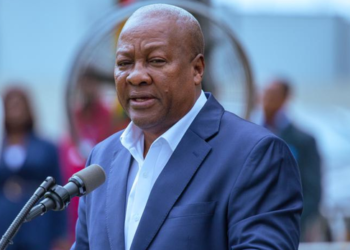
A heated debate over the strengthening Ghanaian Cedi unfolded in Parliament on Thursday, as Minority Leader Alexander Afenyo-Markin challenged claims that the currency’s recent stability is a direct result of policies implemented by the current Mahama-led administration.
Addressing the House during deliberations on the 2025 Mid-Year Budget Review, the Effutu MP dismissed what he termed as “politically convenient” assertions by the governing National Democratic Congress (NDC) that the Cedi’s appreciation is evidence of their economic competence.
“We welcome the Cedi’s gains — it’s good for the economy and good for the people,” Afenyo-Markin stated. “But it’s misleading to attribute this entirely to the NDC. The truth is, the trajectory toward recovery was already set in motion under the previous NPP administration.”
His comments come amid growing political debate over the roots of Ghana’s recent currency gains, with the Finance Minister, Dr. Cassiel Ato Forson, touting the appreciation as a major achievement under the NDC’s fiscal strategy.
But Afenyo-Markin pushed back, arguing that the groundwork for the current stability was laid in 2023 and 2024 — before the NDC returned to power — through key macroeconomic reforms initiated under the New Patriotic Party (NPP), especially in the context of the IMF support programme.
“A major factor is renewed investor confidence and inflows driven by the IMF agreement and an improved fiscal outlook,” he said. “This process didn’t begin this year — it was a product of tough decisions and recovery frameworks adopted by the NPP.”
He also cited increased gold exports and remittances in late 2024 as contributing forces that buoyed the Cedi, stressing that external dynamics and structural improvements, not just current policy decisions, are at play.
In a pointed critique, Afenyo-Markin accused the NDC of “economic revisionism,” claiming that while they publicly deny the achievements of the previous administration, they have acknowledged those gains in engagements with the International Monetary Fund.
“Let’s not be selective with the truth. The IMF has clearly cited continuity in reforms and acknowledged that the current stability builds on foundations laid by the Akufo-Addo government. Even the NDC’s own submissions to the IMF reflect that,” he added.
His remarks highlight the growing tension in Parliament over who deserves credit for Ghana’s economic improvements, particularly as the 2025 fiscal calendar progresses and both sides begin positioning ahead of the 2026 elections.
While the appreciation of the Cedi has been broadly welcomed across the political divide, it has now become a symbol of contested narratives — between an administration keen to showcase progress, and an opposition determined to claim credit for laying the groundwork.