Organisations of Persons with Disabilities (OPDs) have intensified calls on Parliament to urgently pass the Persons with Disabilities Bill, 2026, describing the proposed legislation as a critical step toward building a more inclusive society.
The groups said disability should not be viewed as an issue affecting only a particular section of the population, stressing that anyone can experience disability due to changing life circumstances.
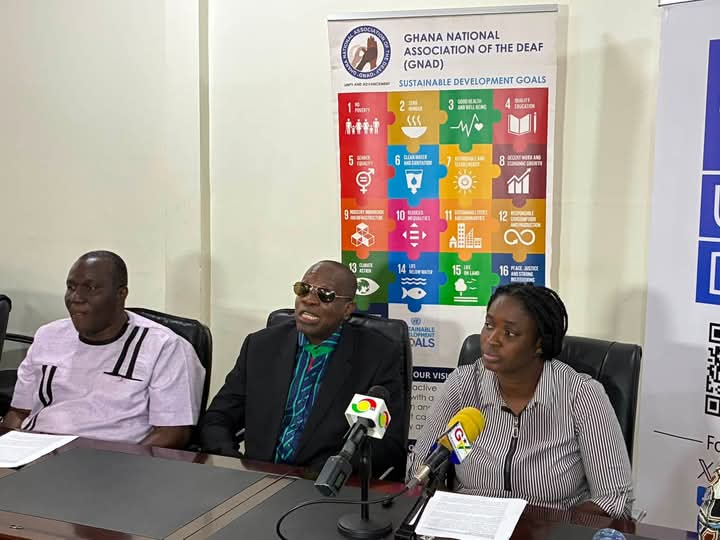
Speaking at a press engagement in Accra, Executive Director of the Inclusive Family Alliance, Mrs. Hannah Awadzi, said disability was a shared human reality that required collective action and stronger legal protections.
Mrs. Awadzi, who presented a statement on behalf of the Ghana National Association of the Deaf (GNAD) and other disability organisations, said the difference between the words “DIS” and “ABILITY” was only a small distance, underscoring how quickly a person’s circumstances could change.
“Disability is no respecter of persons. It does not discriminate. It can touch a neighbour, a colleague, a family member, or even you,” she said.
The engagement was organised by GNAD under the Global Disability Fund Joint Programme, with participation from the Ghana Federation of Disability Organisations, Inclusion Ghana, Ghana Society of the Physically Disabled, Ghana Blind Union, Inclusive Family Alliance, Mental Health Society of Ghana and other disability advocacy groups.
The organisations noted that although Ghana enacted the Persons with Disabilities Act, 2006 (Act 715), many people living with disabilities continue to encounter barriers in accessing education, healthcare, employment opportunities, transportation and justice services.
Mrs. Awadzi attributed the slow progress to weak enforcement mechanisms and limited sanctions under the existing law, which she said had affected the implementation of provisions relating to accessible infrastructure and inclusive services.
She explained that the proposed Persons with Disabilities Bill, 2026, seeks to address these gaps by introducing stronger anti-discrimination measures, enforceable accessibility requirements and improved accountability systems.
According to her, passing the Bill would not amount to providing special treatment for persons with disabilities but would fulfil Ghana’s constitutional responsibility to protect the dignity, rights and participation of all citizens.
She appealed to Parliament to prioritise the legislation beyond political interests and urged civil society groups, religious organisations, traditional leaders and the private sector to support efforts toward greater inclusion.
The disability groups also called on the media to continue championing disability rights, challenge harmful stereotypes and promote accessible communication in news and public information.
Mrs. Awadzi stressed that supporting the Bill would benefit not only the estimated 2.1 million Ghanaians currently living with disabilities but also future generations who may require similar protections.
“Supporting this Bill means protecting not just 2.1 million Ghanaians living with disabilities today, but the future of every Ghanaian,” she said.