
















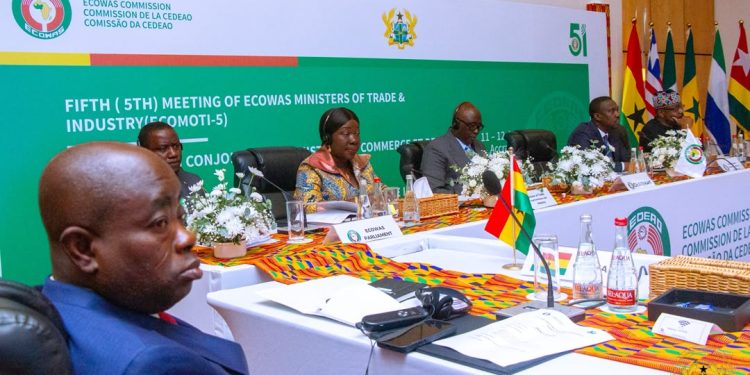
West African trade ministers have renewed calls for urgent reforms to boost regional commerce, as concerns grow over the low level of trade among ECOWAS member states despite the bloc’s vast economic potential.
Speaking at the opening of the Fifth Joint Meeting of ECOWAS Ministers of Trade and Industry (ECOMOTI-5) in Accra, Ghana’s Minister for Trade, Agribusiness and Industry, Elizabeth Ofosu-Adjare, highlighted the need to eliminate obstacles that continue to hinder trade and industrial growth across the sub-region.
She noted that although ECOWAS boasts a population of more than 350 million people and a combined Gross Domestic Product approaching US$700 billion, trade among member states remains below 15 percent of total commerce.
According to the minister, challenges such as inadequate transport infrastructure, unreliable energy supply, multiple currencies, unharmonised customs systems and persistent non-tariff barriers continue to limit the movement of goods and services across borders.
She warned that non-tariff barriers alone add between 15 and 20 percent to the cost of cross-border trade, increasing expenses for businesses and consumers while weakening regional competitiveness.
To reverse the trend, Ofosu-Adjare called for stronger collaboration in developing regional value chains, particularly in sectors such as textiles, apparel and automobile manufacturing. She urged member states to promote local production, increase the use of regional raw materials and strengthen industrial partnerships under the African Continental Free Trade Area (AfCFTA).
The minister also stressed the importance of presenting a united front in global trade negotiations, particularly following discussions at the Fourteenth World Trade Organization Ministerial Conference in Yaoundé. She said ECOWAS countries must ensure that international trade agreements support Africa’s industrialisation and development agenda.
As host of the AfCFTA Secretariat, Ghana reaffirmed its commitment to advancing policies that promote seamless trade, industrial growth and job creation across the continent.
The meeting also heard calls for stronger political commitment to implementing existing regional agreements. Chairperson of the ECOWAS Parliament Committee on Trade, Customs and Free Movement, Amdiatta Diaby, urged member states to move beyond policy discussions and focus on effective implementation to unlock the full benefits of regional integration.
Meanwhile, Sierra Leone’s Minister for Trade and Chair of ECOMOTI-5, Alpha Ibrahim Sesay, cautioned against bilateral trade arrangements that could undermine the ECOWAS Customs Union and weaken the region’s collective bargaining power.
The conference is expected to advance discussions on key regional initiatives, including the West Africa Common Industrial Policy (WACIP) 2026–2030, harmonised food standards, the Cross-Border Consumer Protection Regulation and the ECOWAS Common Investment Market.
Participants expressed optimism that stronger cooperation and coordinated action will help build a more competitive, integrated and prosperous West African economy.






