
















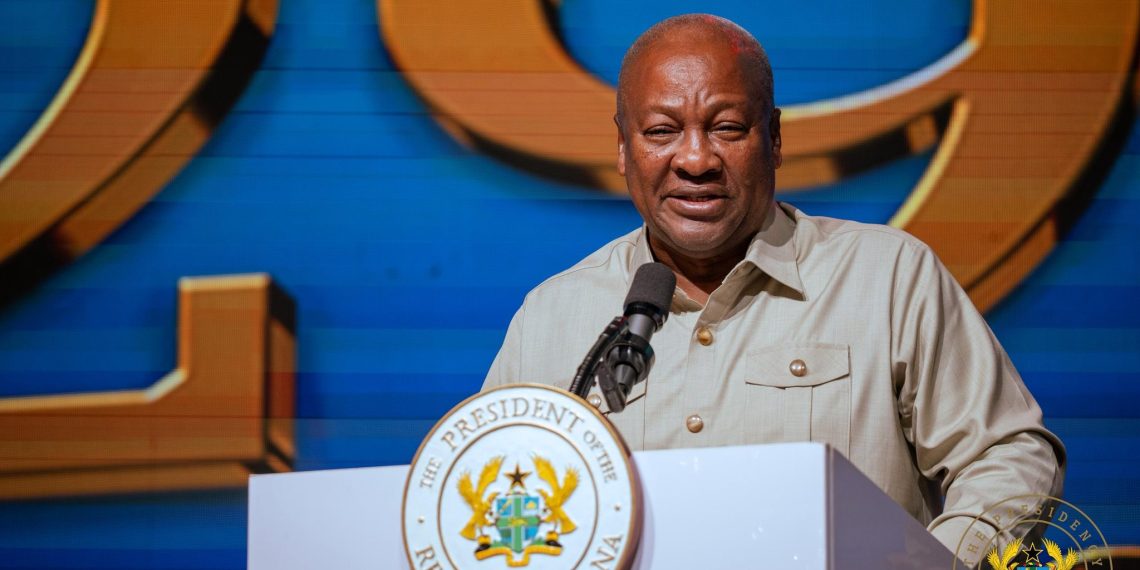
President John Dramani Mahama has outlined Ghana’s readiness to deepen economic cooperation with global partners, stressing that the country is actively reforming its economy to attract long-term, strategic investment rather than short-term capital inflows.
Speaking at the 12th Africa Debate held at the Guildhall in London, and organised by Invest Africa in collaboration with the UK Government, the President said Ghana is reshaping its business environment to improve predictability, transparency, and investor confidence under a broad reform agenda.
He explained that government is undertaking wide-ranging infrastructure expansion across transport, energy, logistics, digital systems, and industrial zones, with flagship initiatives such as the “Big Push” programme designed to unlock opportunities in roads, rail, housing, water systems, and energy development.
According to him, these efforts are aimed at positioning Ghana as a competitive hub for manufacturing, trade, and regional connectivity within West Africa, while also increasing domestic participation in foreign-led investments.
President Mahama told investors that Ghana offers political stability, democratic continuity, and a strategic gateway to the West African market, adding that reforms underway are intended to ensure a clearer and more predictable investment climate.
He also used the platform to call for a reset of global economic relations, arguing that current financial systems remain uneven, particularly in areas such as borrowing costs, climate finance delivery, and access to technology.
He said African economies continue to face structural disadvantages despite their growth potential, and urged reforms that promote fairer trade, value addition, and industrial development on the continent.
“True partnership requires trade that rewards value addition,” he noted, adding that Africa should not remain primarily an exporter of raw materials while importing finished goods at higher cost.
The President further called for faster and more inclusive debt restructuring mechanisms, stressing that Africa bears a disproportionate burden of climate change impacts despite contributing the least to global emissions.
He argued that Africa’s digital transformation and industrial growth must be driven by collaboration, knowledge sharing, and equitable global governance reforms that reflect the continent’s growing demographic and economic importance.
On relations with the United Kingdom, President Mahama said there is a strong opportunity to redefine cooperation beyond historical ties, toward a more strategic economic partnership focused on investment, trade expansion, technology transfer, and skills development.
He said such a shift would support Africa’s industrialisation agenda while enabling the UK to diversify trade, expand investment opportunities, and strengthen cooperation in energy transition and innovation.
“Africa is not a risk to be managed. Africa is an opportunity to be seized,” he said, adding that Ghana is ready to serve as a reliable entry point for investors seeking access to African markets.
President Mahama concluded that Ghana and Africa are actively building their economic future and called for partnerships grounded in mutual benefit, innovation, and shared prosperity.
UK Minister of State for International Development, Baroness Chapman, also announced a new UK–African Union Partnership Programme aimed at strengthening cooperation in peace and security, climate action, trade, and economic growth across the continent.






