
















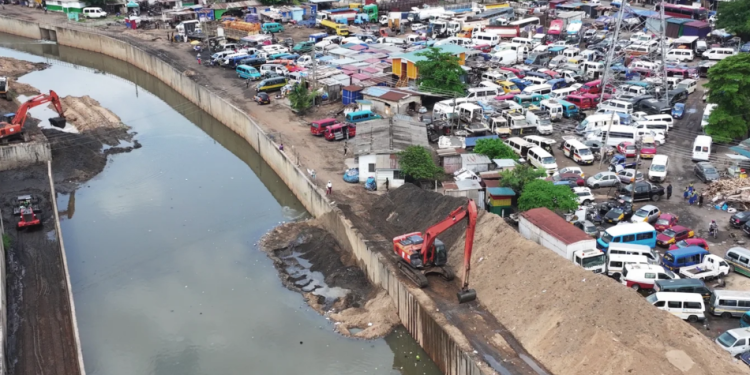
The IMANI Centre for Policy and Education has raised fresh concerns over the effectiveness of ongoing flood mitigation efforts in Accra, warning that governance and implementation challenges—rather than funding alone—may undermine the Greater Accra Resilient and Integrated Development (GARID) project.
In a policy brief released on Monday, June 8, 2026, titled “GARID and Urban Governance as Adaptation and Strategic Measures to Address Perennial Floods,” the policy think tank questioned whether remaining resources under the World Bank–funded programme are sufficient to deliver the scale of interventions required to address the capital’s long-standing flooding crisis.
IMANI noted that despite significant investment over the years, Accra continues to suffer repeated floods, building collapses, and fire outbreaks. It referenced the June 3, 2015 disaster, which claimed more than 150 lives, as a reminder of the city’s persistent vulnerability to environmental and infrastructural failures.
The GARID project was designed to strengthen drainage systems, improve waste management, and reduce climate-related risks, particularly within the Odaw River Basin. However, IMANI argues that the pace and depth of implementation have not matched the urgency of the problem.
According to the brief, the project initially received $350 million in funding, but $65 million was later diverted by the World Bank to support COVID-19 emergency response efforts, leaving about $285 million for core infrastructure works.
IMANI further indicated that as of June 2025, over $118 million had already been spent from a total of $127 million disbursed, significantly narrowing the financial space for remaining interventions.
The organisation warned that spreading the remaining resources across 17 metropolitan, municipal, and district assemblies could dilute impact, especially given the technical complexity of works required in flood-prone areas such as the Odaw Basin.
While acknowledging progress in some drainage and waste management interventions, IMANI described overall outcomes as incremental, rather than transformative, in addressing Accra’s chronic flooding challenges.
The report also highlighted uneven implementation capacity across project units, noting that while some teams demonstrate strong technical competence, others continue to face staffing gaps and limited engineering capacity.
Citing its November 2025 governance and accountability study, IMANI pointed to unfinished works in communities such as Agbogbloshie, where residents continue to experience flooding despite ongoing project extensions now stretching to 2027.
Beyond funding constraints, the think tank identified contractor performance, institutional weaknesses, and coordination failures as key risks that could limit the project’s overall effectiveness.
It argued that even adequate financing would not guarantee success if oversight mechanisms remain weak and implementation bottlenecks persist.
“If funds are available but execution is constrained by weak supervision and limited institutional capacity, then governance becomes the decisive factor,” the brief suggested.
IMANI cautioned that Ghana’s approach to GARID must shift from routine project management to a more urgent, results-driven framework that reflects the scale of climate-related risks facing Accra.
The organisation called for stronger oversight structures, improved inter-agency coordination, and more efficient use of remaining resources to ensure the project delivers long-term flood resilience for the capital.
Without such reforms, it warned, Accra will remain exposed to recurring disasters despite ongoing investments in infrastructure and climate adaptation.






