
















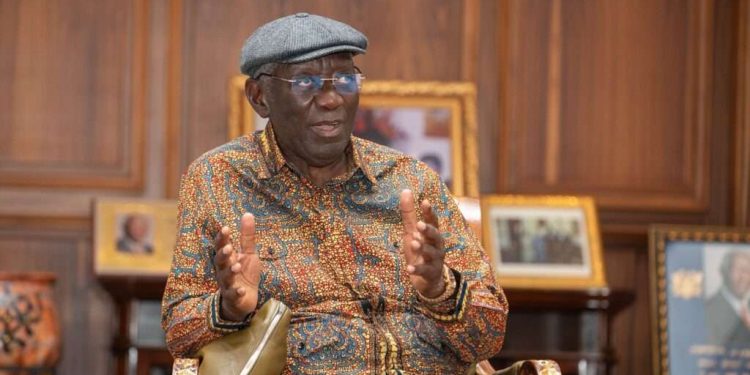
Former President John Agyekum Kufuor has renewed calls for Ghana to extend its presidential term from four to five years, arguing that the current arrangement limits the time governments have to implement development policies before attention shifts to the next election.
Mr Kufuor said a five-year term would allow governments to focus on delivering their programmes for four years, leaving the fifth year for election campaigns and the contest for a renewed mandate.
In an exclusive interview with JoyNews’ Evans Mensah, the former President drew on his experience in office to argue that four years was too short for a developing country seeking to accelerate economic and social transformation.
“Four years is too short for a young nation that is trying to develop,” he said.
Mr Kufuor explained that the final year of the current presidential term was often dominated by political campaigning, public promises and efforts by parties to secure another mandate, potentially distracting governments from their development priorities.
He argued that extending the term would create a clearer separation between the period for implementing government policies and the period for campaigning ahead of an election.
“Fourth year is an election year, election year anywhere in the world is a mud year, everybody is going around promising and talking, and then the election comes, and you have to pay something to the voter to put you back, what is the benefit?” he said.
The former President maintained that his support for the proposal was informed by practical experience rather than a desire to extend the tenure of individual officeholders.
“I believe in the two terms (a system that allows an individual to become president for two separate terms), but four years for a developing young country like ours, and I have gone through the experience, so I spoke from practical experience, and it was my last state of the nation address that I brought it up, I didn’t say it to lengthen my stay,” he added.
Mr Kufuor’s position puts him at odds with the official stance of his party, the New Patriotic Party (NPP), which has opposed the proposal.
He acknowledged the difference in opinion, saying the party was entitled to maintain its position even though he believed a five-year term would better serve Ghana’s development needs.
“Now I say five years, if for whatever reason my party (NPP) says no, that is their point of view,” he emphasised.
The proposal is part of Ghana’s ongoing constitutional review process and has yet to receive parliamentary approval and presidential assent to become law.
The debate centres on whether an additional year in office would give successive governments greater room to implement policies and complete development projects, or whether the existing four-year term remains the more appropriate arrangement for Ghana’s democratic system.






