
















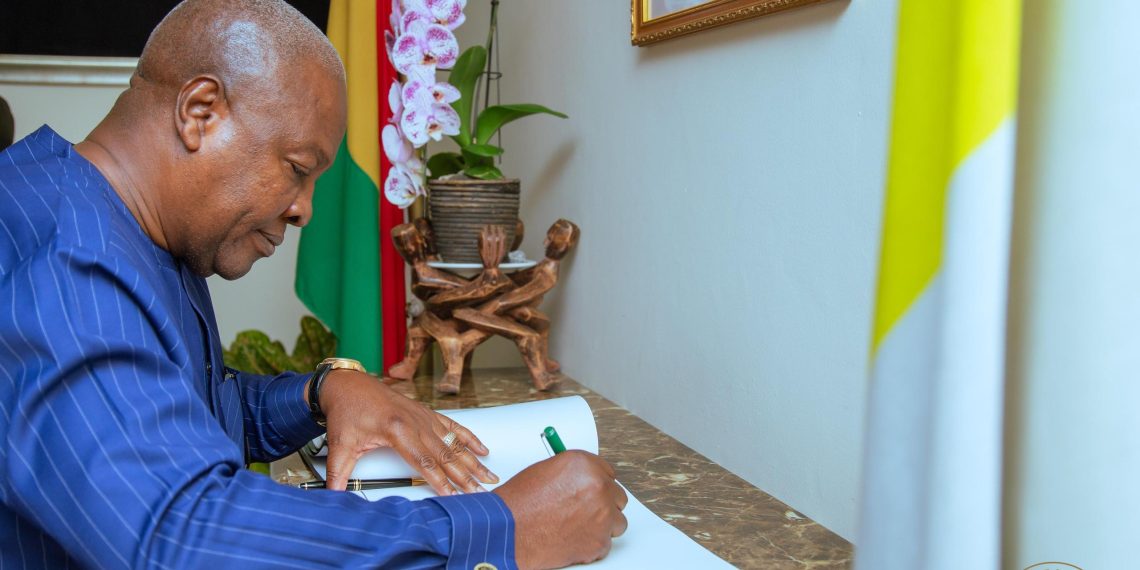
President John Dramani Mahama has thrown his weight behind a bold proposal that would require senior public officials to cultivate tree crop plantations, positioning the move as a practical pathway to job creation, export growth and long-term economic resilience.
Speaking at the 2026 Tree Crops Investment Summit and Exhibition in Accra, the President endorsed a policy advanced by the Tree Crops Development Authority (TCDA) that would mandate ministers, Members of Parliament, civil servants and other government appointees to own and manage a minimum of 25 acres of tree crops within their ecological zones.
Framing the proposal as leadership by example, President Mahama revealed that he personally owns a 50-acre cocoa farm and has recently begun cultivating a 100-acre oil palm plantation. He argued that public officials must demonstrate commitment to agriculture if they expect citizens to “go back to the land.”
“We must walk the talk,” he stressed, noting that in neighbouring Côte d’Ivoire, many public servants maintain farms alongside their official duties.
The proposed policy could go even further, with the TCDA indicating that compliance may become a criterion for public appointments or qualification to contest parliamentary elections — a move that would firmly anchor agriculture within Ghana’s governance framework.
Chief Executive Officer of the TCDA, Dr. Andy Osei Okrah, projected that the initiative could raise export earnings by 20 to 30 percent and generate up to 500,000 new jobs by 2030 if fully implemented. He also described tree crop farming as a reliable retirement plan for public servants, urging colleagues to invest in plantations and processing ventures as long-term income sources.
The TCDA, which oversees the development of cashew, coconut, oil palm, rubber, mango and shea, is pursuing reforms under five strategic pillars: expanding production, improving productivity, boosting industrial growth and value addition, strengthening regulation and standards, and enhancing data and digital systems.
President Mahama underscored that Ghana must reduce its dependence on single-commodity exports and diversify its agricultural base to build a more resilient economy. The proposed mandatory farming policy, he suggested, could signal a transformative shift in how public leadership contributes directly to national development.






