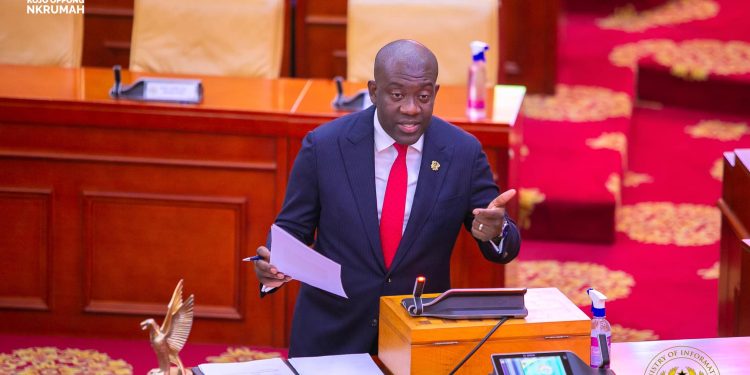
Member of Parliament for Ofoase-Ayirebi, Kojo Oppong Nkrumah, has raised concerns over what he describes as a deepening youth unemployment crisis in Ghana, revealing that nearly two million young people are currently neither working nor pursuing education or skills training.
Addressing Parliament on Thursday, the legislator cited data from the Ghana Statistical Service (GSS), indicating that 1.34 million young people aged between 15 and 24 fall into the category of Not in Education, Employment, or Training (NEET). When Ghana’s broader National Youth Policy definition, which covers persons up to age 35, is applied, the figure increases to 1.95 million.
“Nearly two million young Ghanaians are neither earning nor learning,” Mr Oppong Nkrumah told Parliament, warning that the situation poses serious economic and social risks for the country.
According to him, youth unemployment continues to worsen, with the jobless rate among people aged 15 to 24 rising from 32 percent in December 2024 to 32.5 percent by the third quarter of 2025.
He highlighted the situation in Greater Accra as particularly troubling, noting that youth unemployment in the region reached 49.3 percent during the same period.
“That means almost one in every two young people in our capital region is unemployed,” he said.
Mr Oppong Nkrumah further observed that seven out of every ten unemployed Ghanaians are under the age of 35, reinforcing the need for urgent interventions targeted at young people.
While acknowledging that previous governments, including the New Patriotic Party (NPP) administration, had not fully resolved the challenge, he stressed that the issue requires collective national attention rather than partisan debate.
The MP questioned whether current government initiatives aimed at job creation are producing the intended results. He cited programmes such as the 24-Hour Economy, the One Million Coders Programme, the Adwumawura Programme and the government’s pledge to create 250,000 jobs annually.
On the 24-Hour Economy policy, he noted that although it was launched in July 2025, the Authority Bill only reached Parliament in February 2026, with concerns already emerging over whether it adequately addresses job creation through shift systems.
Regarding the One Million Coders Programme, he said the initiative attracted more than 90,000 applications within 48 hours of its launch, demonstrating strong demand among young people for employment and skills development opportunities. However, he noted that the programme’s website later went offline before being relaunched with plans to admit 30,000 participants in its first cohort.
Mr Oppong Nkrumah urged government to ensure the effective implementation of its flagship employment initiatives, arguing that young Ghanaians need tangible opportunities rather than promises.
“The burden is getting worse, and the question before this House today is what is being done now to tackle it and whether it is working,” he said.
He called for bipartisan efforts to address youth unemployment, warning that Ghana’s future economic growth and social stability depend largely on creating sustainable jobs and opportunities for its youthful population.